
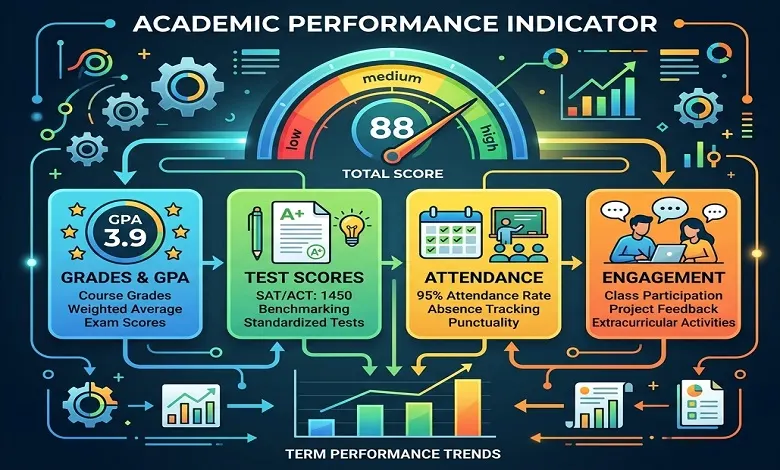
Academic performance involves much more than examination marks or grades. Students, teachers, academic departments, and educational institutions may need to be evaluated across different aspects of teaching, learning, research, progress, and academic engagement. An Academic Performance Indicator (API) provides a measurable way to assess or monitor a specific aspect of academic performance.
The meaning of an Academic Performance Indicator depends on the context. For students, relevant indicators may include examination results, grades, course completion, academic progress, and achievement of learning outcomes. In higher education, indicators can also relate to teaching activities, research contributions, professional responsibilities, and other academic work.
In India, the term Academic Performance Indicator (API) also has a specific historical connection with the University Grants Commission (UGC) and its Performance Based Appraisal System (PBAS) for university and college teachers. Because UGC regulations have changed over time, historical API scoring systems should not automatically be treated as current requirements.
This guide explains what an Academic Performance Indicator means, the different types of academic indicators, practical examples, how academic performance can be measured, the historical UGC API context, and the advantages and limitations of using performance indicators in education.
What is an Academic Performance Indicator?
An Academic Performance Indicator (API) is a measurable factor used to evaluate or monitor a particular aspect of academic performance.
The indicator can be quantitative, such as an examination score or course completion rate, or it can be based on structured evidence related to teaching, research, learning, or academic participation.
For example, a university may use examination results to understand student achievement, while a faculty assessment system may consider teaching activities, research contributions, publications, or other defined academic responsibilities.
The important point is that an indicator should have a clear purpose. A number by itself does not explain the complete quality of academic performance.
For example, a student’s examination score may indicate achievement in a particular assessment, but it may not fully explain the student’s practical knowledge, improvement over time, participation, or ability to apply what they have learned.
Similarly, the number of research publications may indicate research output, but publication count alone does not necessarily describe the quality, relevance, or impact of the research.
Therefore, organizations generally need to consider several relevant indicators together and interpret them in the context in which they are being used.
What Does API Mean in Education?
In education, API can mean Academic Performance Indicator.
The term can be used broadly to describe measurements of academic performance. However, in Indian higher education, API also has a more specific historical meaning connected with the UGC’s Performance Based Appraisal System (PBAS) for university and college teachers.
This distinction is important.
In a general educational context, an Academic Performance Indicator might refer to:
- Examination results
- Grades
- Student progression
- Course completion
- Learning outcomes
- Attendance
- Teaching activities
- Research output
In the historical UGC context, API referred to defined categories of academic activities and associated scores used as part of faculty appraisal and career advancement arrangements under particular regulations.
Therefore, anyone searching for an “API score” should first determine which context they mean. A student performance indicator and a historical UGC faculty API are not the same thing.
Academic Performance Indicator vs Academic Performance
It is important to understand the difference between academic performance and academic performance indicators.
Academic performance refers to the actual achievement level, such as grades, test scores, or completed qualifications.
On the other hand, academic performance indicators are the tools or metrics used to measure and evaluate that performance.
For example:
- Academic performance → A student scores 85% in exams
- Academic performance indicator → GPA, attendance rate, assignment completion, participation
This distinction is important because indicators provide context, not just results.
Why Academic Performance Indicators are Important
The role of academic performance indicators has become more important as education systems move toward data-driven decision-making.
Better Understanding of Learning Progress
Academic performance indicators help track how students are progressing over time. Instead of relying on one exam, they show patterns, strengths, and areas that need improvement.
They provide meaningful insights into student achievements and classroom progress, helping educators adjust their teaching methods.
Support for Decision Making
Educational institutions use academic performance indicators to make decisions about:
- Promotions and hiring of faculty
- Curriculum development
- Student support programs
In many systems, API scores are directly linked to career advancement and evaluation processes.
Improvement of Teaching and Learning
By analyzing indicators, teachers can identify which methods are effective and which are not.
For example, if a group of students shows low performance in a specific area, it may indicate:
- Teaching gaps
- Lack of resources
- Need for additional support
This allows for targeted improvements.
Accountability and Transparency
Academic performance indicators create a system of accountability. Institutions can measure performance objectively and compare results across departments or time periods.
This helps maintain educational standards and ensures consistency.
Types of Academic Performance Indicators
Academic performance can be measured in different ways depending on whether the focus is on students, teachers, programmes, or institutions.
1. Student Achievement Indicators
These indicators focus on academic results and learning achievement.
Examples include:
- Examination scores
- Course grades
- Grade point average
- Assignment results
- Assessment scores
- Achievement of learning outcomes
These measurements can provide useful information about academic achievement, but they do not necessarily represent every aspect of learning.
2. Student Progress Indicators
Progress indicators focus on how a student’s academic performance changes over time.
Examples include:
- Improvement between assessments
- Progress toward learning objectives
- Credit accumulation
- Course progression
- Year-to-year academic development
Progress can be particularly useful because students may begin a course with different levels of prior knowledge.
3. Course Completion Indicators
Completion indicators show whether students successfully finish courses or programmes.
Examples include:
- Course completion rate
- Programme completion rate
- Graduation rate
- Credit completion
These indicators can help institutions identify potential progression problems.
4. Engagement Indicators
Engagement indicators provide information about participation in the learning process.
Examples include:
- Attendance
- Assignment submission
- Class participation
- Use of online learning resources
- Participation in academic activities
Engagement should not automatically be treated as proof of academic achievement. It is better understood as supporting information.
5. Teaching Indicators
At the faculty level, academic indicators may relate to teaching and educational responsibilities.
Depending on the institution, these may include:
- Teaching activities
- Course development
- Student assessment
- Academic mentoring
- Curriculum contribution
- Professional development
- Teaching innovation
The indicators should be based on clearly defined institutional requirements.
6. Research Indicators
Research performance can be evaluated using several measures.
Examples may include:
- Research publications
- Citations
- Research projects
- Grants
- Patents
- Conference contributions
- Books and book chapters
- Research supervision
However, quantity alone does not necessarily indicate research quality. Research indicators should be interpreted in context.
7. Institutional Indicators
Institutions may use broader measures to understand academic outcomes.
These can include:
- Student retention
- Completion rates
- Progression
- Learning outcomes
- Research activity
- Student achievement
- Programme outcomes
The appropriate indicators depend on the institution’s objectives and the educational context.
Academic Performance Indicator Examples
Consider a university that wants to understand the academic performance of an undergraduate programme.
Instead of relying on one measurement, it could monitor several indicators:
| Area | Example Indicator | What It Can Indicate |
| Achievement | Average assessment score | Academic achievement |
| Progress | Improvement over time | Student development |
| Completion | Course completion rate | Successful course completion |
| Retention | Students continuing the programme | Student persistence |
| Engagement | Attendance or participation | Learning engagement |
| Learning | Achievement of learning outcomes | Whether expected learning occurred |
Suppose 180 out of 200 enrolled students complete a course.
The completion rate would be:
180 ÷ 200 × 100 = 90%
The result provides useful information, but it does not explain everything about the course.
For example, a 90% completion rate does not automatically demonstrate that students achieved all intended learning outcomes. Additional evidence may be needed to understand examination performance, learning outcomes, student experience, and other relevant factors.
This illustrates an important principle: an academic performance indicator should be interpreted as evidence about a specific aspect of performance, not as a complete description of academic quality.
How Is Academic Performance Measured?
Measuring academic performance begins with identifying exactly what needs to be understood.
Step 1: Define the Objective
Start with a clear question.
For example:
- Are students achieving the expected learning outcomes?
- Are students progressing through the programme?
- Are examination results improving?
- Which courses require additional support?
- Are academic staff meeting defined responsibilities?
Step 2: Select Relevant Indicators
Choose measurements that directly relate to the objective.
If the goal is to evaluate learning achievement, assessment results may be appropriate.
If the goal is to understand progression, completion and progression rates may provide more useful information.
Step 3: Define the Measurement
Clearly explain how the indicator will be calculated.
For example:
Course Completion Rate = Students completing the course ÷ Total enrolled students × 100
A clearly defined formula makes the indicator easier to understand and compare.
Step 4: Collect Reliable Data
Information may come from:
- Examination systems
- Student information systems
- Learning management systems
- Attendance records
- Academic records
- Surveys
- Research databases
Data quality is important because inaccurate or incomplete information can produce misleading results.
Step 5: Analyze the Results
Look at trends and relevant context rather than focusing on one number.
Consider whether there were changes in:
- Curriculum
- Assessment methods
- Student groups
- Admission criteria
- Teaching arrangements
- Data collection methods
Step 6: Use the Findings
The purpose of measurement is to support appropriate action. Depending on the findings, an institution may decide to provide additional student support, review a course, improve teaching resources, offer faculty development, or conduct further investigation.
How Academic Performance Indicators are Measured
Measuring academic performance indicators involves both quantitative and qualitative methods.
Quantitative indicators include numerical data such as:
- Scores
- Percentages
- Rankings
Qualitative indicators focus on aspects that are harder to measure, such as:
- Student engagement
- Classroom environment
- Teaching quality
Modern education systems often combine both approaches to get a more complete understanding of performance.
Academic Performance Indicator and UGC
The term Academic Performance Indicator (API) has an important historical connection with the University Grants Commission (UGC) in India.
UGC introduced API-related provisions within its Performance Based Appraisal System (PBAS) for university and college teachers. The framework was associated with the assessment of academic activities and was also connected with faculty career advancement under applicable regulations.
Historical API/PBAS frameworks included areas such as:
- Teaching and learning activities
- Examination and evaluation-related work
- Professional and academic contributions
- Research and scholarly activities
- Other defined academic responsibilities
The specific categories, scoring requirements, and applicable rules have changed through different UGC regulations and amendments.
Is the UGC API Score Still the Same?
This is an important point for anyone researching API requirements for recruitment or promotion.
Older articles and documents may contain API tables and scoring systems from previous UGC regulations. Those historical requirements should not automatically be presented as the current rule.
The applicable requirements depend on the relevant regulation, amendment, university, institution, and purpose of the assessment.
Therefore, candidates and faculty members who need an official API-related score should verify the requirements against the latest applicable UGC regulations and the rules of their institution.
The UGC’s official regulations and notifications should be treated as the primary source for regulatory information rather than relying on an old blog post or third-party API calculator.
Factors Affecting Academic Performance Indicators
Academic performance indicators are influenced by multiple factors.
Student Factors
- Motivation and interest
- Study habits
- Attendance
- Health and well-being
Teaching Factors
- Teaching methods
- Classroom interaction
- Curriculum design
Environmental Factors
- School infrastructure
- Access to resources
- Family and social environment
These factors show that performance indicators are not just about ability—they reflect a broader context.
Advantages of Academic Performance Indicators
Using academic performance indicators provides several benefits.
They offer a structured way to measure progress, making it easier to track improvement over time.
They help identify strengths and weaknesses, allowing targeted interventions.
They also support data-driven decision-making, improving overall educational quality.
Additionally, they provide a common framework that allows comparison across students, teachers, and institutions.
Benefits of Academic Performance Indicators
When carefully designed and interpreted, academic performance indicators can provide useful information to educational institutions and educators.
Better Understanding of Performance
Indicators can make specific aspects of academic performance easier to observe and monitor.
Early Identification of Problems
Changes in achievement, progression, completion, or engagement may highlight areas that require further investigation.
Support for Academic Planning
Performance information can contribute to decisions about student support, curriculum development, faculty development, and programme improvement.
Progress Monitoring
Consistent indicators can help institutions monitor changes over time.
More Structured Evaluation
Clearly defined indicators provide a more systematic approach to evaluating selected academic outcomes.
However, indicators work best when combined with appropriate context and professional judgment rather than being treated as the complete measure of educational quality.
Limitations of Academic Performance Indicators
Academic performance indicators can be useful, but they also have limitations.
A Single Number Can Oversimplify Performance
Education involves knowledge, skills, behaviour, development, teaching quality, and other factors that cannot always be represented by one score.
Indicators Can Be Misinterpreted
A relationship between two measurements does not necessarily prove that one caused the other.
For example, lower attendance and lower examination results may occur together, but additional evidence is needed to determine the reasons.
Data Quality Affects Results
Incomplete, inaccurate, or inconsistent data can reduce the reliability of an indicator.
Context Matters
Academic results can be affected by course difficulty, student characteristics, assessment design, teaching resources, and other circumstances.
Quantity Does Not Always Represent Quality
Counting publications, assignments, attendance records, or other outputs does not automatically establish their quality or impact.
For this reason, academic indicators should generally be treated as evidence that contributes to evaluation rather than as a complete replacement for professional judgment.
Keep technology short and useful
Technology and Academic Performance Indicators
Digital technology has made it easier for educational institutions to collect, organize, and analyze academic information.
Institutions may use:
- Learning management systems
- Student information systems
- Digital assessment platforms
- Attendance systems
- Academic dashboards
- Research information systems
These systems can help track selected indicators, identify trends, produce reports, and monitor progress.
However, technology does not automatically make an indicator meaningful. Institutions still need to decide what should be measured, why it matters, whether the data is reliable, and how the results should be interpreted.
Automated analytics can support decision-making, but academic indicators should still be reviewed in their appropriate educational context.
Role of Academic Performance Indicators in Modern Education
In today’s education system, academic performance indicators play a central role.
They are used in:
- School evaluations
- University rankings
- Teacher assessments
- Student progress tracking
With the use of data analysis and technology, these indicators help institutions develop better strategies and improve learning outcomes.
They also support personalized learning by identifying individual student needs.
Future of Academic Performance Indicators
The future of academic performance indicators is evolving with technology.
Data analytics, artificial intelligence, and digital learning platforms are changing how performance is measured.
Future indicators may include:
- Real-time learning analytics
- Behavioural and engagement metrics
- Personalized performance tracking
This shift will make performance measurement more accurate and adaptive.
Practical Examples of Academic Performance Indicators
To understand better, consider a few real-life situations.
A student may not have the highest grades, but shows consistent improvement over time. This improvement is captured by performance indicators.
A teacher may receive strong feedback from students and maintain high course completion rates. These indicators reflect teaching effectiveness.
An institution may have high graduation rates and strong employment outcomes. These indicators show overall performance.
These examples highlight how indicators provide context, not just results.
Conclusion
An Academic Performance Indicator provides a structured way to measure or monitor a particular aspect of academic performance. It can help educators and institutions understand achievement, progress, completion, engagement, teaching activity, research output, and other relevant outcomes.
The most useful approach is not to depend on one number. Instead, institutions should select indicators that match their objectives, define how those indicators are measured, collect reliable data, and interpret the results within the appropriate educational context.
The term also has a specific historical meaning in Indian higher education because the UGC used Academic Performance Indicators within its Performance Based Appraisal System for university and college teachers. Since regulations and requirements can change, historical API scoring information should always be distinguished from current official requirements.
Ultimately, academic performance indicators are most valuable when they provide meaningful evidence that can support better educational planning, student development, academic improvement, and informed decision-making.
FAQs:
Q: What is an Academic Performance Indicator?
A. An Academic Performance Indicator is a measurable factor used to evaluate or monitor a specific aspect of academic performance.
Q: What does API stand for in education?
A. API can stand for Academic Performance Indicator. In Indian higher education, the term also has a specific historical association with the UGC’s Performance Based Appraisal System for university and college teachers.
Q: What are examples of Academic Performance Indicators?
A. Examples include examination results, grades, GPA, course completion, academic progression, achievement of learning outcomes, attendance, teaching activities, and research output.
Q: Is GPA an Academic Performance Indicator?
A. GPA can be used as an indicator of student academic achievement where the education system uses GPA. However, GPA does not necessarily measure every aspect of academic performance.
Q: What is an API score?
A. The meaning of an API score depends on the context. In historical UGC/PBAS frameworks in India, API scores were associated with defined academic activities used in faculty appraisal and career advancement arrangements under applicable regulations.
Q: Is UGC API still applicable?
A. The answer depends on the specific UGC regulation, institution, and purpose. Historical UGC API frameworks should not automatically be assumed to represent current requirements. Anyone needing an official requirement should check the latest applicable UGC regulations and institutional rules.
Q: Is Academic Performance Indicator the same as Academic Performance Index?
A. Not necessarily. An indicator generally represents a particular measurement, while an index may combine multiple measurements into a composite value. The exact terminology depends on the system being discussed.
Q: Why are Academic Performance Indicators important?
A. They can help institutions monitor academic outcomes, identify areas requiring attention, evaluate progress, and support planning and development.
Q: Can one indicator measure overall academic performance?
A. Usually, no. A single indicator normally measures only one aspect of performance. Multiple relevant indicators can provide a broader picture.
Q: Are Academic Performance Indicators only used for students?
A. No. Depending on the context, academic performance indicators can be used for students, teachers, programmes, departments, and educational institutions.
Q: How often should academic performance be measured?
A. There is no universal schedule. The appropriate frequency depends on the indicator, educational setting, purpose, and institutional requirements. Some indicators may be reviewed during a semester, while others may be more useful annually or over several academic years.