
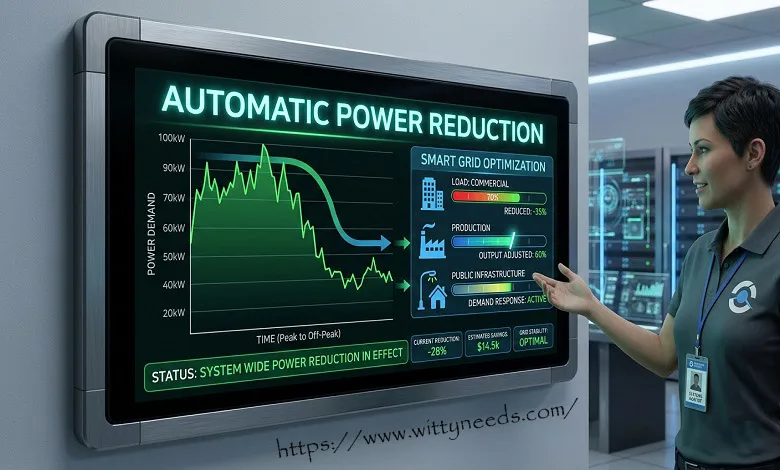
If you’ve ever worked with high-powered electronic or communication systems, you’ll know one thing for sure—power is not just about performance, it’s also about control. Too much power at the wrong time can cause serious problems, from equipment damage to safety risks. That’s exactly where automatic power reduction comes in.
Unlike manual adjustments, which depend on someone noticing a problem and reacting, automatic systems respond instantly. They don’t wait for instructions. They monitor conditions continuously and step in the moment something goes wrong. That ability to react in real time is what makes automatic power reduction so important in today’s technology-driven environments.
This isn’t just a feature added for convenience. In many systems, it’s a built-in safety mechanism that prevents costly failures and protects both equipment and people.
What Is Automatic Power Reduction?
To put it simply, automatic power reduction is a system function that lowers power output when certain conditions indicate a risk.
Under normal circumstances, a system runs at its intended power level to deliver optimal performance. But if something unexpected happens—like a disconnection, overload, or abnormal signal—the system immediately reduces power to prevent damage.
What makes this different from regular power control is intent. Power control focuses on maintaining performance, while automatic power reduction focuses on preventing harm.
You can think of it as a built-in reflex. The system doesn’t need to be told what to do. It detects the issue and responds on its own.
Why Automatic Power Reduction Is So Important
It’s easy to overlook something like automatic power reduction because it usually works quietly in the background. But its importance becomes very clear the moment something goes wrong.
In high-power systems, even a brief fault can cause serious damage. Without a protective mechanism, excessive energy can overheat components, damage circuits, or create unsafe conditions.
Take fibre optic systems as an example. These systems often use powerful laser signals to transmit data. If a fibre cable breaks or disconnects, that energy doesn’t just disappear—it can be exposed. Since these signals are invisible, the risk is even greater.
Automatic power reduction steps in immediately, lowering the power before it becomes dangerous. That quick response is what prevents accidents and keeps systems stable.
Beyond safety, it also helps reduce repair costs. Preventing damage is always cheaper than fixing it later.
How Automatic Power Reduction Works in Real Systems
At a practical level, automatic power reduction works through constant monitoring and fast response.
Every system that uses this feature keeps track of certain parameters. These might include signal strength, temperature, connection status, or electrical load. As long as everything stays within normal limits, the system continues operating at full power.
The moment something changes—such as a sudden drop in signal or an unexpected interruption—the system recognizes that something is wrong.
Instead of waiting, it reacts immediately. Power output is reduced to a safe level, sometimes within milliseconds. This prevents further stress on the system and gives it time to stabilize.
In more advanced setups, the system doesn’t just stop there. It keeps checking conditions in the background. Once everything returns to normal, it gradually restores power.
This cycle of monitoring, reacting, and recovering is what makes automatic power reduction reliable and effective.
Automatic Power Reduction in Optical and Telecom Systems
One of the most critical uses of automatic power reduction is in optical communication.
Fibre optic networks rely on high-powered light signals to transmit large amounts of data over long distances. While this is efficient, it also introduces risk.
If a fibre line is cut or disconnected, the signal can leak out. Because the light is not visible, it can pose a hazard without any obvious warning.
Automatic power reduction solves this by detecting signal loss and reducing output immediately. This protects technicians working on the system and prevents unnecessary exposure.
In fact, in many telecom environments, this feature is not optional—it’s required for safety compliance.
Differences Between Automatic Power Reduction and Regular Power Control
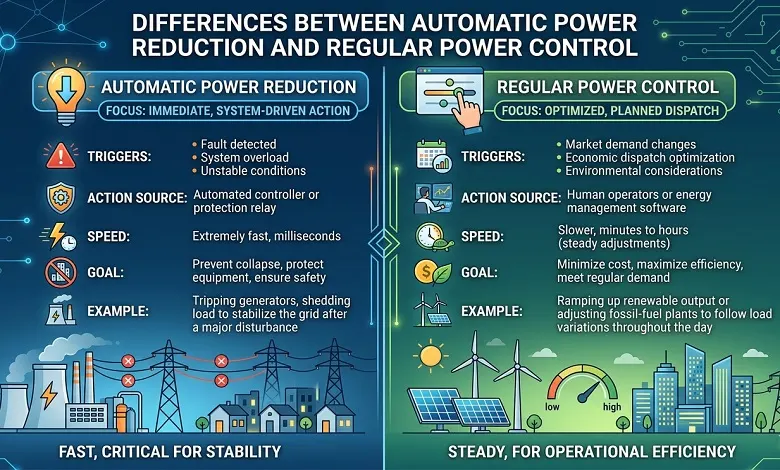
It’s common to confuse automatic power reduction with standard power management systems, but they are not the same.
Regular power control is about maintaining consistent performance. It adjusts power levels slightly to keep the system running smoothly.
Automatic power reduction, on the other hand, is designed for abnormal situations. It only activates when something goes wrong.
A simple way to understand the difference is this:
- Power control keeps things running efficiently
- Automatic power reduction steps in when something is at risk
Both are important, but they serve very different purposes.
Key Benefits of Automatic Power Reduction
Once you understand how it works, the benefits of automatic power reduction become obvious.
One of the biggest advantages is safety. Systems that include this feature are far less likely to cause harm during unexpected situations.
It also helps protect equipment. High power levels can damage components quickly, especially during faults. Reducing power prevents long-term damage and extends the life of the system.
Another benefit is reliability. Systems that can adjust themselves during problems are less likely to fail. Instead of shutting down, they stabilize and continue operating at a safe level.
There’s also a financial benefit. Preventing damage means fewer repairs, less downtime, and lower maintenance costs.
Where Automatic Power Reduction Is Used
Although it is often associated with telecom systems, automatic power reduction is used in many different areas.
In computing, processors reduce power when temperatures rise too high. This prevents overheating and keeps devices running smoothly.
In industrial systems, machines reduce power when they detect overload conditions. This protects both the equipment and the production process.
In energy systems, similar concepts are used to balance supply and demand. Power is adjusted automatically to maintain stability.
Even in everyday devices like smartphones, power reduction mechanisms are used to manage battery life and temperature.
This wide range of applications shows how important this concept has become across industries.
Challenges and Practical Limitations
Like any system, automatic power reduction is not perfect.
One challenge is finding the right balance. If the system is too sensitive, it may reduce power unnecessarily, which can affect performance.
On the other hand, if it’s not sensitive enough, it may respond too late.
Another issue is recovery. Once power is reduced, the system needs to determine when it is safe to return to normal operation. This requires careful monitoring and accurate decision-making.
Despite these challenges, modern systems have become much better at handling these situations, making automatic power reduction more reliable than ever.
Why Automatic Power Reduction Is Becoming More Important
As technology continues to evolve, systems are becoming more powerful and more complex. With higher power levels comes greater risk.
At the same time, there is an increasing demand for reliability. Systems are expected to run continuously without failure.
This combination makes automatic power reduction more important than ever. It allows systems to handle unexpected situations without human intervention.
In many cases, it’s the difference between a minor issue and a major failure.
Final Thoughts
When you look at modern systems closely, you start to realize that performance alone is not enough. Stability, safety, and reliability are just as important.
That’s where automatic power reduction proves its value.
It works quietly in the background, stepping in only when needed, preventing damage before it happens. Most of the time, users don’t even notice it—but that’s exactly the point.
It’s one of those features you hope you never need, but you’re glad it’s there when something goes wrong.
Short FAQs on Automatic Power Reduction
Q: What does automatic power reduction do?
A: It automatically lowers the power output of a system when it detects a problem or unsafe condition.
Q: Is automatic power reduction the same as power saving?
A: No, power saving focuses on efficiency, while automatic power reduction focuses on safety during abnormal conditions.
Q: Where is automatic power reduction commonly used?
A: It is widely used in telecom systems, electronics, industrial machines, and computing devices.
Q: Does automatic power reduction affect performance?
A: Temporarily, yes. But it prevents larger issues that could cause complete system failure.
Q: Can automatic power reduction be turned off?
A: In most systems, it is built in for safety reasons and should not be disabled.