

Cities around the world are becoming more connected than ever before. From intelligent traffic signals and digital public transportation systems to smart energy grids and environmental monitoring, modern urban infrastructure generates enormous amounts of information every second. Managing this information effectively has become one of the biggest challenges—and opportunities—for governments and city planners. This is where smart city data management plays a critical role. It provides the framework for collecting, organizing, storing, analyzing, and securing data generated by connected devices, public services, and digital infrastructure. When managed correctly, this data helps city officials make faster decisions, improve public services, reduce operational costs, and create a better quality of life for residents.
However, data alone doesn’t make a city “smart.” Success depends on implementing effective smart city data management strategies that ensure information is accurate, secure, accessible, and used responsibly. Without a well-defined strategy, cities may struggle with fragmented systems, cybersecurity risks, privacy concerns, and inefficient decision-making.
In this guide, we’ll explore how smart city data management works, why it’s essential for modern urban development, and the strategies that help cities transform raw information into meaningful action.
What Is Smart City Data Management?
Smart city data management refers to the processes, technologies, and governance practices used to handle the vast amount of data generated across an urban environment.
Data flows continuously from multiple sources, including:
- Internet of Things (IoT) sensors
- Traffic management systems
- Smart streetlights
- Public transportation networks
- Utility meters
- Environmental monitoring stations
- Surveillance systems
- Emergency response services
- Citizen service platforms
Instead of allowing this information to remain isolated within different departments, a smart city data management system integrates these data sources into a unified framework. This enables decision-makers to access reliable information, identify trends, and respond more effectively to changing conditions.
The ultimate objective is not simply collecting data but converting it into actionable insights that improve city operations and public services.
Why Smart City Data Management Matters
As urban populations continue to grow, cities face increasing pressure to deliver better services while managing limited resources. Traditional management methods often rely on manual reporting, disconnected systems, and delayed decision-making.
An effective smart city data management approach helps overcome these limitations by providing real-time visibility into city operations.
Some of the key benefits include:
Better Decision-Making
City leaders can monitor traffic patterns, energy consumption, waste collection, and emergency incidents in real time. This enables faster and more informed decisions.
Improved Public Services
Accurate data helps optimize public transportation schedules, improve water distribution, reduce power outages, and enhance emergency response times.
Cost Savings
Analyzing operational data allows municipalities to identify inefficiencies, reduce maintenance costs, and allocate resources more effectively.
Environmental Sustainability
Smart city platforms monitor air quality, water usage, emissions, and energy consumption, supporting sustainability goals and environmental compliance.
Enhanced Citizen Experience
Residents benefit from improved transportation, cleaner streets, faster municipal services, and better communication with local government.
Types of Data Collected in Smart Cities
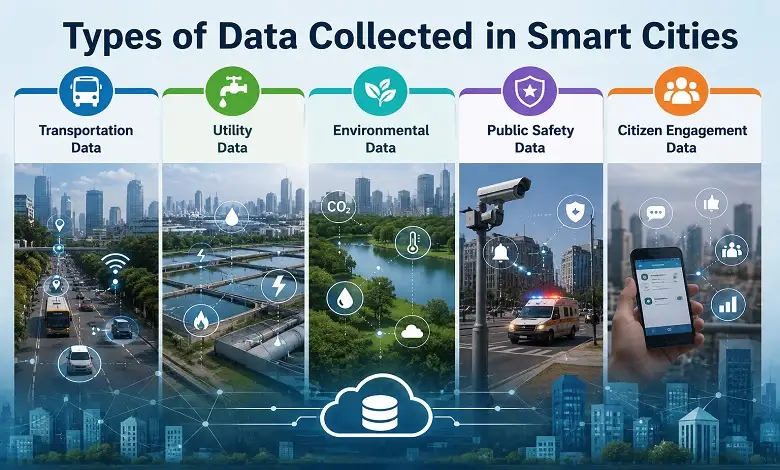
Modern cities generate information from nearly every aspect of urban life.
Understanding these data categories is essential when developing effective smart city data management strategies.
Transportation Data
Transportation systems continuously collect information such as:
- Vehicle movement
- Traffic congestion
- Parking availability
- Public transit schedules
- Bicycle-sharing usage
- Accident reports
This data helps optimize traffic flow and reduce congestion.
Utility Data
Smart utility systems generate information related to:
- Electricity consumption
- Water usage
- Gas distribution
- Renewable energy production
- Smart grid performance
These insights help utilities improve efficiency while reducing operational costs.
Environmental Data
Environmental monitoring systems collect information including:
- Air quality
- Temperature
- Humidity
- Rainfall
- Noise pollution
- Water quality
Such data support climate initiatives and public health programs.
Public Safety Data
Emergency services and public safety agencies rely on data from:
- CCTV cameras
- Emergency call systems
- Disaster monitoring
- Fire detection sensors
- Crime reporting platforms
Integrating this information improves emergency response and situational awareness.
Citizen Engagement Data
Many cities now offer digital portals and mobile applications that allow residents to:
- Report issues
- Submit service requests
- Pay utility bills
- Provide feedback
- Access municipal information
This information helps governments understand community needs and improve service delivery.
Core Components of Smart City Data Management
Managing city-wide information requires more than simply installing sensors.
Successful systems rely on several interconnected components.
Data Collection
The first stage involves gathering information from connected devices, government departments, public services, and citizen applications.
Modern cities often deploy thousands of IoT sensors that continuously transmit operational data.
Data Integration
Data collected from different departments frequently exists in separate systems.
Integration platforms combine these diverse data sources into a unified environment, eliminating information silos and improving collaboration across agencies.
Data Storage
Large volumes of structured and unstructured information require a scalable storage infrastructure.
Many municipalities use cloud-based platforms because they provide flexibility, high availability, and cost-effective scalability.
Hybrid cloud models are also becoming increasingly common for handling sensitive government information.
Data Processing
Raw information has limited value until it is processed.
Analytics platforms clean, organize, validate, and prepare data for reporting, dashboards, predictive analytics, and operational decision-making.
Real-time processing enables city managers to respond quickly to changing conditions.
Data Visualization
Interactive dashboards help city officials interpret complex information.
Instead of reviewing spreadsheets, decision-makers can monitor key performance indicators through visual charts, maps, and live operational displays.
Effective visualization improves both understanding and response times.
Smart City Data Management Strategies for Long-Term Success
Developing a connected city requires more than advanced technology. Municipalities also need clear governance, security, and operational planning.
Below are several proven smart city data management strategies that help cities maximize the value of their data.
1. Establish a Unified Data Governance Framework
Every department should follow consistent standards for collecting, storing, sharing, and protecting information.
A comprehensive governance framework defines:
- Data ownership
- Quality standards
- Security policies
- Access permissions
- Compliance requirements
- Data lifecycle management
Without clear governance, data becomes inconsistent and difficult to trust.
2. Break Down Departmental Silos
Many cities still operate separate systems for transportation, utilities, healthcare, and emergency services.
Integrated data platforms encourage collaboration by enabling departments to share relevant information while maintaining appropriate security controls.
Cross-department collaboration often leads to faster problem-solving and better public services.
3. Prioritize Data Quality
Even sophisticated analytics tools cannot compensate for inaccurate or incomplete information.
Cities should establish processes for:
- Data validation
- Error detection
- Duplicate removal
- Standardized formats
- Regular quality audits
High-quality data forms the foundation of effective decision-making.
4. Design for Scalability
Urban populations continue to grow, and connected infrastructure expands every year.
Smart city data management systems should be designed with future growth in mind, allowing new sensors, applications, and services to integrate without requiring major system redesigns.
Scalable architecture helps municipalities adapt to changing technology while protecting long-term investments.
Challenges Facing Smart City Data Management
Although connected technologies offer significant benefits, implementing them presents several challenges.
Common issues include:
- Cybersecurity threats
- Data privacy concerns
- Legacy infrastructure
- High implementation costs
- Integration complexity
- Lack of standardized data formats
- Limited technical expertise
Addressing these challenges requires not only advanced technology but also strong governance, workforce training, and long-term planning.
Advanced Smart City Data Management Strategies
As cities continue to digitize public services, data management must evolve beyond simple collection and storage. Municipalities need intelligent systems that can process vast amounts of information securely while supporting real-time decision-making.
The following smart city data management strategies help governments build resilient, scalable, and citizen-focused digital ecosystems.
5. Adopt Cloud-Based Data Infrastructure
Modern smart cities generate terabytes of data every day. Traditional on-premises infrastructure often struggles to scale as connected devices increase.
Cloud computing offers several advantages, including:
- Elastic storage capacity
- High availability
- Automatic backups
- Faster data processing
- Reduced infrastructure costs
- Easier collaboration between departments
Many municipalities also choose hybrid cloud environments, allowing sensitive government data to remain on private infrastructure while less sensitive workloads run in the public cloud.
6. Strengthen Cybersecurity at Every Layer
A connected city is only as secure as its weakest digital asset.
Traffic signals, surveillance cameras, environmental sensors, and utility systems all represent potential entry points for cybercriminals if they are not properly protected.
An effective smart city data management framework should include:
- End-to-end encryption
- Multi-factor authentication
- Network segmentation
- Continuous security monitoring
- Regular vulnerability assessments
- Security awareness training
- Incident response planning
Cybersecurity should be integrated into every stage of the data lifecycle rather than treated as an afterthought.
7. Protect Citizen Privacy
Residents expect governments to use technology responsibly.
Smart cities often collect sensitive information through transportation systems, public services, digital identities, and mobile applications. Without clear privacy policies, public trust can quickly decline.
Good privacy practices include:
- Collecting only necessary data
- Removing personally identifiable information when possible
- Defining clear data retention periods
- Restricting unauthorized access
- Maintaining transparency about how information is used
Strong privacy governance not only protects citizens but also supports compliance with national and regional data protection regulations.
8. Enable Real-Time Analytics
Waiting hours—or even days—to analyze city data limits its usefulness.
Real-time analytics allows city managers to detect problems immediately and respond before they escalate.
Examples include:
- Adjusting traffic signals during congestion
- Dispatching emergency responders more efficiently
- Detecting water leaks
- Monitoring air pollution spikes
- Managing energy demand
When combined with AI and predictive analytics, real-time insights can significantly improve operational efficiency.
9. Encourage Open Data Initiatives
Many cities publish non-sensitive datasets for researchers, developers, startups, and businesses.
Open data encourages innovation by allowing third parties to develop applications that improve transportation, tourism, public safety, and civic engagement.
Examples of public datasets include:
- Transit schedules
- Weather information
- Road closures
- Parking availability
- Air quality measurements
- Population statistics
Proper governance ensures transparency while protecting confidential information.
The Role of Emerging Technologies
Technology is the driving force behind every successful smart city data management initiative. Several innovations are reshaping how urban data is collected, analyzed, and utilized.
Artificial Intelligence
Artificial intelligence helps cities process enormous volumes of information more efficiently than manual analysis.
AI applications include:
- Predictive traffic management
- Energy demand forecasting
- Waste collection optimization
- Emergency response support
- Infrastructure maintenance prediction
- Public service automation
By identifying patterns within complex datasets, AI enables faster and more informed decisions.
Internet of Things (IoT)
IoT devices serve as the primary source of information for smart cities.
Examples include:
- Smart parking sensors
- Connected streetlights
- Environmental monitoring stations
- Smart electricity meters
- Water quality sensors
- Flood detection systems
These connected devices continuously generate data that feeds centralized management platforms.
Edge Computing
Not every decision can wait for cloud processing.
Edge computing analyzes data closer to where it is generated, reducing latency and improving response times.
For example:
- Traffic cameras can detect accidents instantly.
- Smart intersections can adjust signals within seconds.
- Industrial sensors can identify equipment failures before damage occurs.
This technology is becoming increasingly important for time-sensitive city operations.
Digital Twins
Digital twins create virtual replicas of physical city infrastructure.
By combining live sensor data with simulation models, city planners can test different scenarios before making real-world changes.
Potential applications include:
- Traffic planning
- Flood risk analysis
- Infrastructure maintenance
- Energy optimization
- Urban development projects
Digital twins reduce planning risks while improving long-term decision-making.
Best Practices for Smart City Data Management
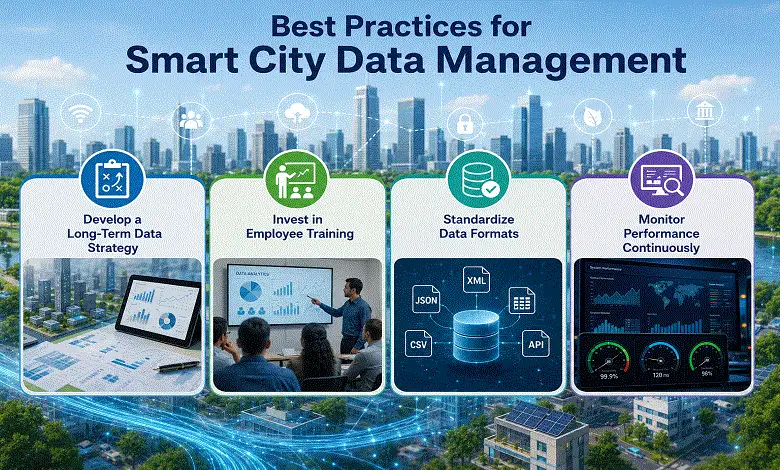
Technology alone cannot create an intelligent city. Long-term success depends on governance, collaboration, and continuous improvement.
Successful municipalities often follow these best practices:
Develop a Long-Term Data Strategy
Cities should establish measurable objectives before investing in new technologies.
Questions to consider include:
- What problems are we trying to solve?
- Which departments need shared access?
- How will success be measured?
A clear roadmap prevents fragmented investments.
Invest in Employee Training
Technology evolves rapidly.
City employees should receive ongoing training in:
- Data literacy
- Cybersecurity
- Analytics
- AI applications
- Privacy regulations
- Digital governance
Well-trained teams make better use of available technology.
Standardize Data Formats
Different departments frequently collect information using incompatible systems.
Standardized formats enhance interoperability and reduce integration costs, enabling cross-departmental collaboration.
Monitor Performance Continuously
Data management should be viewed as an ongoing process rather than a one-time implementation.
Cities should regularly evaluate:
- Data quality
- Security performance
- System uptime
- Citizen satisfaction
- Operational efficiency
- Cost savings
Continuous improvement ensures that digital infrastructure remains effective over time.
Real-World Examples of Smart City Data Management
Several cities around the world demonstrate how effective data management can improve urban life.
Singapore
Singapore integrates transportation, environmental monitoring, and public services through connected digital infrastructure. Real-time analytics supports traffic optimization, energy efficiency, and urban planning.
Barcelona
Barcelona uses IoT technologies for smart lighting, waste collection, irrigation, and parking management. Data-driven decision-making has improved operational efficiency while reducing resource consumption.
Amsterdam
Amsterdam encourages collaboration between government agencies, businesses, universities, and citizens through open data initiatives and sustainable technology projects.
These examples illustrate how comprehensive smart city data management strategies can improve both operational performance and quality of life.
Future Trends in Smart City Data Management
Several emerging trends will shape the future of urban data management.
Key developments include:
- AI-powered decision support
- Autonomous transportation systems
- 5G-enabled IoT networks
- Expanded digital twin adoption
- Greater use of predictive analytics
- Privacy-enhancing technologies
- Sustainable data centres
- Climate resilience analytics
As technology continues to mature, cities will increasingly rely on intelligent data ecosystems to address population growth, infrastructure demands, and environmental challenges.
Conclusion
As cities become increasingly connected, smart city data management is no longer simply a technology initiative—it is a strategic requirement for sustainable urban development. The ability to collect, integrate, analyze, and protect data enables governments to make informed decisions, improve operational efficiency, and deliver better public services.
Implementing effective smart city data management strategies requires more than deploying sensors or adopting cloud platforms. It involves establishing strong governance, prioritizing cybersecurity and privacy, maintaining high data quality, and fostering collaboration across departments. When these elements work together, cities can transform raw information into actionable insights that enhance transportation, energy management, public safety, environmental sustainability, and citizen engagement.
Looking ahead, innovations such as artificial intelligence, IoT, edge computing, and digital twins will continue to reshape how cities manage information. Municipalities that invest in scalable infrastructure, responsible data governance, and continuous innovation will be better positioned to address future challenges while creating smarter, safer, and more resilient communities.
Frequently Asked Questions
Q: What is smart city data management?
A. Smart city data management is the process of collecting, integrating, storing, analyzing, protecting, and governing data generated by connected urban infrastructure and public services.
Q: Why are smart city data management strategies important?
A. Effective strategies help cities improve decision-making, enhance public services, strengthen cybersecurity, optimize resource allocation, and support sustainable urban development.
Q: What technologies support smart city data management?
A. Smart city data management relies on IoT sensors, cloud computing, AI, big data analytics, 5G networks, edge computing, and secure data platforms to collect, process, and analyze urban data efficiently.
Q: What are the biggest challenges?
A. The biggest challenges include data security, privacy concerns, system integration, high implementation costs, and ensuring reliable, real-time data sharing across city services.
Q: How does smart city data management improve daily life?
A. It improves daily life by reducing traffic congestion, enhancing public safety, optimizing energy use, improving waste management, and delivering faster, more efficient public services.