
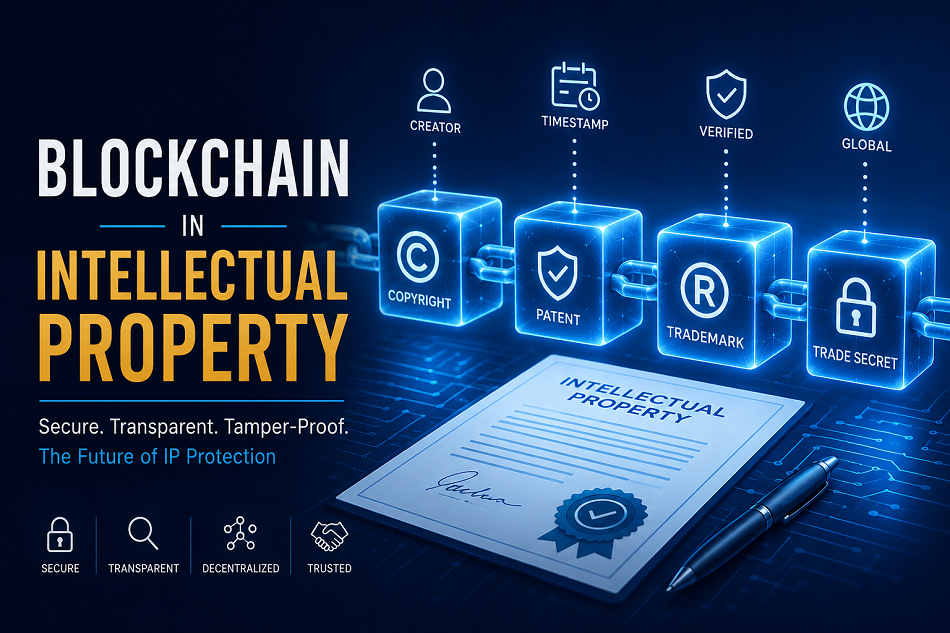
Blockchain in intellectual property is one of the most valuable assets a business, creator, or innovator can own. Whether it’s a patented invention, a copyrighted book, a software application, a trademark, or a piece of digital artwork, protecting original ideas has become increasingly challenging in today’s digital world. Copyright infringement, counterfeit products, piracy, and ownership disputes continue to affect businesses of all sizes, often leading to financial losses and lengthy legal battles.
Blockchain in intellectual property is emerging as a practical solution to many of these challenges. By creating secure, time-stamped, and tamper-proof digital records, blockchain helps establish proof of ownership, simplify licensing, improve royalty payments, and increase transparency throughout the intellectual property lifecycle. While it doesn’t replace copyright, trademark, or patent laws, blockchain strengthens existing IP systems by providing reliable evidence of ownership and transaction history.
What Is Blockchain in Intellectual Property?
Blockchain is a decentralized digital ledger that records information across multiple computers instead of storing it in a single central database. Every transaction added to the blockchain is encrypted, verified by the network, and linked to previous records, making it extremely difficult to alter or delete.
When applied to intellectual property, blockchain creates a permanent digital record of ownership, creation dates, licensing agreements, and asset transfers. Instead of relying solely on paper documents or centralized databases, creators can use blockchain to establish an immutable record that proves when a work was created and who owns it.
For example, a software developer can record the cryptographic hash of source code on a blockchain before releasing a new application. Similarly, a photographer can timestamp original images, while a musician can register a newly composed song before publishing it online.
Why Is Blockchain Important for Intellectual Property Rights?
Managing intellectual property has become increasingly complex as businesses expand globally and digital content can be copied within seconds. Traditional IP systems often involve multiple intermediaries, lengthy paperwork, and costly legal procedures.
Blockchain addresses many of these challenges by providing a transparent and verifiable record of every important transaction related to an intellectual asset.
Some of the biggest reasons businesses are adopting blockchain in intellectual property include:
- Establishing clear proof of ownership
- Preventing unauthorized modifications
- Improving copyright protection
- Reducing licensing disputes
- Automating royalty payments
- Increasing transparency between creators and buyers
- Strengthening anti-counterfeiting efforts
Because every transaction is permanently recorded, stakeholders can verify ownership without relying entirely on centralized databases.
How Blockchain Works in Intellectual Property
To understand the value of blockchain in intellectual property, it’s helpful to see how the process works in practice.
Step 1: Create the Intellectual Property
The process begins when an inventor, artist, author, software developer, or business creates an original asset. This could include:
- A patentable invention
- Software code
- A research paper
- Digital artwork
- Music
- A company logo
- A product design
Step 2: Generate a Digital Fingerprint
Instead of uploading the entire file to the blockchain, most platforms create a unique cryptographic hash of the original work. This digital fingerprint is unique to that specific file.
Even a tiny modification to the file creates a completely different hash, making it easy to detect alterations.
Step 3: Record the Asset on the Blockchain
The hash, ownership details, timestamp, and transaction information are recorded on the blockchain.
Once recorded, the information cannot be modified without network consensus.
Step 4: Manage Ownership and Licensing
Whenever ownership changes or licensing agreements are signed, additional blockchain transactions are created.
This builds a complete history of the intellectual property’s lifecycle—from creation to licensing and eventual transfer.
Key Benefits of Blockchain in Intellectual Property
Blockchain offers several advantages over traditional methods of managing intellectual property.
1. Stronger Proof of Ownership
One of the biggest challenges in intellectual property disputes is proving who created a work first.
Blockchain provides a trusted timestamp that records when an asset existed. Since blockchain records cannot easily be altered, they create reliable evidence that supports ownership claims.
This is especially valuable for digital creators whose work is frequently copied or redistributed online.
2. Better Copyright Protection
Copyright infringement remains one of the largest challenges for writers, photographers, musicians, filmmakers, and software developers.
Blockchain helps creators maintain an authenticated record of their original work. If unauthorized copies appear elsewhere, blockchain records can help demonstrate which version came first.
Although legal enforcement still depends on national copyright laws, blockchain simplifies the process of proving originality.
3. Improved Transparency
Traditional intellectual property transactions often involve publishers, legal firms, licensing agencies, and distributors.
Blockchain records every transaction on a shared ledger, allowing authorized parties to verify ownership history without depending on multiple intermediaries.
This transparency reduces misunderstandings and increases trust between creators, investors, and licensing partners.
4. Enhanced Security
Unlike centralized databases that may be vulnerable to hacking or accidental data loss, blockchain distributes records across multiple network Systems.
Each transaction is secured using advanced cryptographic algorithms, making unauthorized modifications extremely difficult.
For businesses managing valuable patents or confidential licensing agreements, this additional layer of security is a major advantage.
5. Faster Verification
Verifying intellectual property ownership through traditional systems can sometimes take days or even weeks.
With blockchain, authorized users can quickly confirm ownership by reviewing recorded transactions.
This speeds up licensing negotiations, acquisitions, partnerships, and due diligence during business transactions.
6. Reduced Administrative Costs
Managing intellectual property often requires significant paperwork and legal administration.
Blockchain automates many routine processes, reducing the need for manual recordkeeping.
As a result, businesses can lower administrative expenses while improving operational efficiency.
How Smart Contracts Improve Intellectual Property Management
One of the most powerful features of blockchain in intellectual property is the use of smart contracts.
A smart contract is a self-executing digital agreement stored on a blockchain. Once predefined conditions are met, the contract automatically performs the agreed action without requiring manual intervention.
For example, imagine a photographer licenses an image to a marketing agency for one year. Instead of manually tracking the agreement, a smart contract can:
- Grant access to the licensed image automatically.
- Record the transaction on the blockchain.
- Collect the licensing fee.
- Distribute payment to the creator instantly.
- Revoke access when the license expires.
This reduces paperwork, minimizes human error, and ensures that both parties follow the agreed terms.
Smart contracts are increasingly being explored for copyright licensing, patent agreements, software subscriptions, and digital content distribution, where automation can save both time and money.
Blockchain and Royalty Management
Royalty distribution is often slow, especially in industries like music, publishing, and digital media. Payments typically pass through several intermediaries before reaching creators, increasing the risk of delays and accounting errors.
Blockchain makes this process more transparent.
Every sale, download, stream, or licensed use can be recorded on the blockchain in real time. Smart contracts can then calculate and distribute royalties automatically according to predefined rules.
For instance, if a song has multiple rights holders, the blockchain system can instantly divide revenue among the singer, songwriter, producer, and publisher based on their agreed percentages. This reduces disputes, improves payment accuracy, and gives creators greater confidence in how their earnings are managed.
Real-World Applications of Blockchain in Intellectual Property
As blockchain technology continues to mature, organizations across different industries are finding new ways to improve intellectual property management. From protecting creative works to preventing counterfeit products, blockchain is helping businesses build a more secure and transparent IP ecosystem.
1. Copyright Protection for Digital Creators
Artists, photographers, writers, musicians, and filmmakers often face the challenge of unauthorized copying and distribution. Once digital content is published online, proving ownership can become difficult.
Blockchain creates a permanent record showing when the original work was created and who owns it. Every transfer, license, or update can also be recorded, creating a transparent ownership history. This makes copyright management more efficient while reducing disputes over originality.
For example, a freelance photographer can register the digital fingerprint of an image on a blockchain before sharing it with clients. If someone later claims ownership, the blockchain record provides strong evidence of the image’s creation date.
2. Patent Protection
Developing a new invention often requires years of research and significant financial investment. During this process, inventors need reliable documentation to prove when an idea was developed.
Blockchain helps by securely recording research milestones, design changes, laboratory notes, and prototype versions with verified timestamps. These records create a chronological history of the invention, which may support patent applications and ownership claims.
Although patent registration still requires approval from the relevant government authority, blockchain provides an additional layer of evidence throughout the innovation process.
3. Trademark Verification
Counterfeit products continue to affect global brands, reducing customer trust and causing significant financial losses.
Blockchain allows manufacturers to record product information from production to final delivery. Every stage of the supply chain can be verified, helping retailers and consumers identify authentic products.
Luxury brands, pharmaceutical companies, and electronics manufacturers are increasingly exploring blockchain to improve product authentication and reduce counterfeiting.
4. Software Licensing
Software piracy remains a major concern for developers and technology companies.
Using blockchain in intellectual property allows software vendors to manage licenses more effectively. Smart contracts can automatically activate, renew, or expire software licenses based on predefined conditions.
This reduces unauthorized software usage while simplifying subscription management for customers.
5. Academic Research and Innovation
Universities and research organizations generate valuable intellectual property through scientific discoveries and technological innovation.
Blockchain helps researchers document their work throughout the development process. Recording research findings with secure timestamps helps establish authorship while encouraging collaboration among institutions without compromising ownership.
6. Digital Art and NFTs
The popularity of NFTs introduced many creators to blockchain-based ownership.
While NFTs themselves do not automatically transfer copyright, they demonstrate how blockchain can verify ownership of unique digital assets. Artists can use blockchain to prove authenticity, record sales, and maintain a transparent ownership history.
For collectors, blockchain reduces uncertainty by providing a permanent record of authenticity.
Industries Benefiting from Blockchain in Intellectual Property
The adoption of blockchain is expanding across multiple industries where intellectual property plays a critical role.
Entertainment: Music labels, filmmakers, streaming platforms, and publishers use blockchain to improve copyright management, licensing, and royalty distribution.
Healthcare: Medical companies invest billions in research and development. Blockchain helps protect pharmaceutical patents, clinical research, and medical innovations throughout the product lifecycle.
Manufacturing: Manufacturers use blockchain to protect product designs, engineering drawings, and industrial patents while improving supply chain transparency.
Fashion and Luxury Goods: Luxury brands rely on blockchain to verify product authenticity and combat counterfeit goods in international markets.
Technology: Software companies use blockchain to protect source code, manage software licenses, and verify ownership of digital products.
Challenges of Using Blockchain in Intellectual Property
Despite its advantages, blockchain is not a perfect solution. Businesses should understand its limitations before adopting the technology.
Legal Recognition: Many countries are still developing regulations regarding blockchain records and digital evidence. While blockchain can strengthen ownership claims, it does not replace official copyright, trademark, or patent registration.
Scalability: Public blockchain networks sometimes experience slower transaction speeds during periods of high demand. Organizations managing thousands of intellectual property records may require scalable blockchain solutions.
Privacy Concerns: Certain intellectual property, such as trade secrets or confidential research, should not be stored on public blockchains.
Many organizations solve this problem by storing sensitive files securely off-chain while recording only encrypted hashes on the blockchain.
Implementation Costs: Building blockchain-based IP management systems requires technical expertise and infrastructure investment.
Although long-term efficiency may offset these costs, smaller organizations may initially find adoption expensive.
Lack of Global Standards: Different blockchain platforms use different technologies and protocols, making interoperability a challenge.
As international standards continue to evolve, greater compatibility between blockchain systems is expected.
The Future of Blockchain in Intellectual Property
Blockchain is expected to play an increasingly important role in intellectual property management over the next decade.
As digital content creation accelerates and artificial intelligence generates new forms of intellectual property, verifying ownership will become even more important. Blockchain offers an efficient way to establish trust without relying solely on centralized systems.
Future developments may include:
- Global blockchain-based IP registries
- AI-generated content verification
- Automated cross-border licensing
- Faster patent collaboration between organizations
- Real-time royalty payments
- Blockchain-powered anti-counterfeiting systems
- Digital identity verification for creators and inventors
Although widespread adoption will take time, blockchain has the potential to simplify many aspects of intellectual property management while increasing transparency and reducing disputes.
Frequently Asked Questions
1. Is blockchain legally recognized for intellectual property?
Blockchain records can strengthen evidence of ownership, but they do not replace official copyright, patent, or trademark registration. Legal recognition varies by country.
2. Can blockchain prevent copyright infringement?
Blockchain cannot stop someone from copying content, but it creates a permanent ownership record that helps creators prove originality and support legal claims.
3. What types of intellectual property can use blockchain?
Blockchain can support the management of copyrights, patents, trademarks, trade secrets, software, digital artwork, research documents, and licensing agreements.
4. Are smart contracts legally enforceable?
In many jurisdictions, smart contracts can be legally enforceable if they meet the legal requirements of a valid contract. Businesses should always seek legal guidance before relying solely on automated agreements.
5. Is blockchain suitable for small businesses?
Yes. Small businesses, startups, freelancers, and independent creators can all benefit from blockchain by improving ownership verification and simplifying licensing processes.
Conclusion
As innovation becomes increasingly digital, protecting intellectual property requires more than traditional paperwork and centralized databases. Blockchain in intellectual property offers a smarter, more transparent way to record ownership, manage licensing, automate royalty payments, and strengthen trust between creators, businesses, and consumers.
While blockchain cannot replace existing intellectual property laws, it complements them by providing secure, tamper-resistant records that improve accountability and reduce ownership disputes. From protecting software and digital art to verifying patents and fighting counterfeit products, blockchain is already transforming how intellectual assets are managed across industries.
As technology continues to evolve and legal frameworks become more supportive, blockchain is likely to become an essential part of modern intellectual property management. Businesses and creators that embrace this technology early will be better positioned to safeguard their innovations, streamline IP operations, and build greater confidence in an increasingly digital marketplace.
2 thoughts on “Blockchain in Intellectual Property: How Blockchain Is Revolutionizing IP Protection and Rights Management”
Comments are closed.