
Introduction
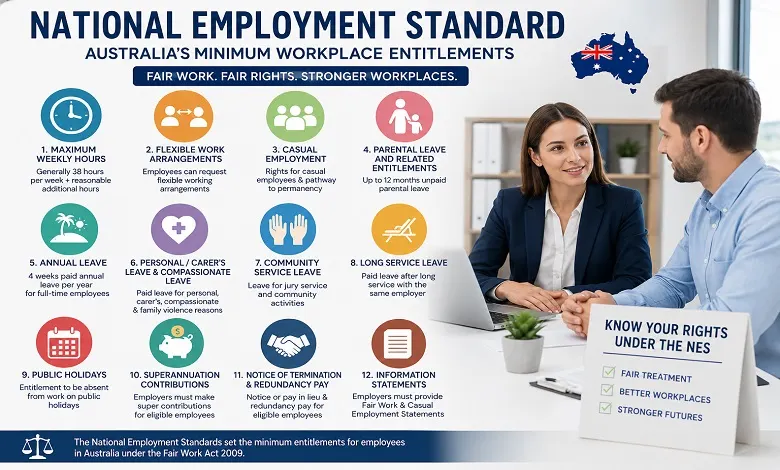
The National Employment Standard—more commonly called the National Employment Standards (NES)—forms the foundation of minimum workplace entitlements in Australia’s national workplace relations system. The NES is established under the Fair Work Act 2009 and covers important areas such as working hours, leave, flexible work, parental leave, public holidays, superannuation, termination, redundancy, and employee information.
For employees, understanding the NES can make workplace rights easier to understand. For employers, knowing how the standards interact with awards, enterprise agreements, and employment contracts is an important part of maintaining compliant HR and payroll practices.
What Is the National Employment Standard?
The National Employment Standards are the minimum employment entitlements that must be provided to employees covered by Australia’s national workplace relations system.
The standards are contained in Part 2-2 of the Fair Work Act 2009. Workplace instruments such as modern awards, enterprise agreements, and employment contracts cannot generally exclude or provide conditions below the NES minimums.
The current Fair Work Ombudsman lists the following NES entitlement areas:
- Maximum weekly hours
- Requests for flexible working arrangements
- Casual employment
- Parental leave and related entitlements
- Annual leave
- Personal/carer’s leave, compassionate leave and family and domestic violence leave
- Community service leave
- Long service leave
- Public holidays
- Superannuation contributions
- Notice of termination and redundancy pay
- Fair Work Information Statement and Casual Employment Information Statement requirements
Why say 12 instead of 11?
You may see the NES described elsewhere as having 11 main employment entitlement categories. That description comes from the structure of the Fair Work Act, where Division 12 covers the Fair Work Information Statement.
However, the current Fair Work Ombudsman guidance separately lists the Fair Work Information Statement and Casual Employment Information Statement alongside the 11 employment-condition categories. For clarity and current accuracy, this article treats them as 12 listed NES entitlement areas.
Why Are the National Employment Standards Important?
The NES creates a minimum safety net for employees.
For workers, this means an employment contract cannot simply remove statutory minimum entitlements that apply to them. For employers, the NES provides a legal baseline that needs to be considered when creating contracts, policies, payroll processes, and workplace procedures.
The standards are particularly important because workplace conditions can come from several different sources, including:
- National Employment Standards
- Modern awards
- Enterprise agreements
- Employment contracts
- Workplace policies
- Other applicable legislation
Understanding how these sources interact is essential. An employee may have rights under the NES as well as additional conditions under an award or enterprise agreement.
The 12 National Employment Standard Areas Explained
1. Maximum Weekly Hours
The NES generally limits the number of hours an employer can request or require an employee to work.
For a full-time employee, the standard maximum is generally 38 hours per week, unless additional hours are reasonable. For other employees, the relevant limit is generally the lesser of 38 hours or their ordinary weekly hours.
Whether additional hours are reasonable can depend on circumstances such as:
- Health and safety
- Personal circumstances
- Family responsibilities
- The nature of the work
- Notice given by the employer
- Workplace requirements
Therefore, the 38-hour figure should not be interpreted as meaning every hour above 38 is automatically unlawful.
2. Requests for Flexible Working Arrangements
Certain employees have a right under the NES to request changes to their working arrangements.
Depending on eligibility, a request may involve:
- Changing start or finish times
- Changing working hours
- Changing work patterns
- Working from another location
Flexible work can be particularly relevant to employees with family or caring responsibilities and certain other circumstances recognized by the Fair Work legislation.
Importantly, having a right to request flexible work does not necessarily mean every request must be accepted. Employers need to follow the applicable rules when considering and responding to eligible requests.
3. Casual Employment
Casual employment has specific rules under the NES.
Casual employees do not receive every entitlement in the same way as permanent employees. For example, they generally do not receive paid annual leave or paid personal/carer’s leave in the same way permanent employees do.
Casual employees do, however, receive certain NES entitlements, including paid family and domestic violence leave and various unpaid leave rights, subject to the applicable requirements.
Casual employment rules have changed over time, so employers should use current Fair Work guidance when determining an employee’s status and rights.
4. Parental Leave and Related Entitlements
The NES provides eligible employees with parental leave and related workplace rights.
These provisions can apply in circumstances involving:
- The birth of a child
- Adoption
- Parental responsibilities
- Sharing parental leave
- Returning to work after parental leave
Eligible employees can generally access up to 12 months of unpaid parental leave, with the ability to request an additional 12 months in certain circumstances.
Parental leave under the NES should be distinguished from government-funded Paid Parental Leave, which operates under a separate government scheme.
Because eligibility and notice requirements can be detailed, employees and employers should check the current rules before making decisions.
5. Annual Leave
Annual leave is one of the most familiar NES entitlements.
Most full-time and part-time employees receive four weeks of paid annual leave for each year of service. Certain shift workers may receive five weeks.
Annual leave generally accumulates progressively while an employee remains employed.
Employers and employees usually agree on when annual leave will be taken. An employer should not unreasonably refuse an employee’s request to take annual leave.
Unused annual leave is generally paid out when employment ends, subject to the applicable rules.
Example
If an eligible full-time employee works continuously for a year, they generally accumulate four weeks of annual leave.
The exact payment calculation can depend on the employee’s applicable rules and employment arrangements, so payroll teams should not assume that every worker’s leave payment is calculated identically.
6. Personal, Carer’s, Compassionate and Family and Domestic Violence Leave
The NES combines several important forms of leave within this entitlement area.
Personal/Carer’s Leave
Eligible full-time employees generally receive 10 days of paid personal/carer’s leave per year, while part-time employees receive a pro-rata entitlement.
Personal leave can apply when an employee is sick or injured or needs to care for an eligible person.
Compassionate Leave
Compassionate leave can apply when a qualifying serious illness, injury, or death affects a member of an employee’s immediate family or household.
Family and Domestic Violence Leave
Eligible employees receive 10 days of paid family and domestic violence leave in each 12-month period under the current NES.
This entitlement is separate from annual and personal leave and has specific confidentiality and evidence-related considerations.
Employees and employers should check the current Fair Work rules for the circumstances in which leave can be taken and what evidence may be requested.
7. Community Service Leave
Community service leave provides eligible employees with leave for certain recognized community activities.
It can include:
- Jury service
- Certain voluntary emergency management activities
The payment and duration of leave can vary depending on the type of community service.
For example, jury service has specific rules concerning payment by an employer, while certain emergency service activities may involve unpaid leave.
The NES therefore recognizes that employees can have important community responsibilities outside their regular employment.
8. Long Service Leave
Long service leave is designed to recognize long periods of service with an employer.
This entitlement is more complicated than annual or personal leave because long service leave can interact with state and territory laws and transitional arrangements.
The applicable entitlement may depend on factors such as:
- Length of service
- State or territory
- Employment history
- Applicable workplace arrangements
Employers should therefore avoid applying a single national calculation to every employee.
For a specific long service leave question, checking the applicable legislation and current Fair Work guidance is important.
9. Public Holidays
The NES provides minimum rights concerning public holidays.
Employees generally have an entitlement to be absent from work on a public holiday, subject to the applicable rules. An employer can request that an employee work on a public holiday when the request is reasonable.
An employee may have a right to refuse an unreasonable request.
Public holiday payments can depend on employment type and the applicable award, agreement, or other workplace arrangement.
This is one reason payroll teams should check the employee’s full employment conditions rather than relying on the NES alone.
10. Superannuation Contributions
Superannuation is another important part of Australia’s employment framework.
The NES includes superannuation contributions as an employment entitlement area. Employers also have obligations under Australia’s separate superannuation guarantee legislation.
The amount and timing of required contributions can depend on current legislation and the employee’s circumstances.
Because superannuation rules can change independently from other employment conditions, businesses should regularly review their payroll settings and contribution processes.
11. Notice of Termination and Redundancy Pay
The NES contains minimum requirements concerning termination of employment and redundancy.
Notice of Termination
The minimum notice period generally depends on the employee’s length of continuous service.
Under the standard NES rules, notice can range from one week to four weeks, with an additional week potentially applying to an employee who is over 45 and has completed at least two years of continuous service.
Redundancy Pay
Redundancy pay may apply when an employee’s position becomes genuinely redundant.
However, eligibility depends on the circumstances, length of service, employer size, and applicable exemptions.
Redundancy should not be confused with dismissal for misconduct or poor performance because the legal requirements can be different.
12. Fair Work Information Statements
The final area concerns information that employers must provide to employees.
Every new employee must receive the Fair Work Information Statement (FWIS) when they start employment. New casual employees must also receive the Casual Employment Information Statement (CEIS) at the required times. Employees entering a new fixed-term contract must receive the applicable Fixed Term Contract Information Statement.
The Fair Work Information Statement explains important workplace rights and conditions, including information about:
- National Employment Standards
- Flexible work
- Awards
- Employment agreements
- Workplace rights
- Termination
- The Fair Work Ombudsman
- The Fair Work Commission
This makes the information statement an important part of employee on boarding.
Who Is Covered by the National Employment Standards?
The NES covers employees in Australia’s national workplace relations system.
The Fair Work Ombudsman states that all employees in that system are covered by the NES regardless of the award, registered agreement, or employment contract that applies to them.
However, the exact entitlement available to an individual can vary.
Factors can include:
- Full-time, part-time, or casual status
- Length of service
- Applicable award
- Enterprise agreement
- Employment contract
- Specific eligibility requirements
For example, casual employees receive only some NES entitlements and may have different rules for accessing particular benefits.
National Employment Standards vs. Modern Awards
The NES and modern awards are closely related but serve different purposes.
The NES establishes minimum statutory entitlements.
A modern award can establish additional minimum conditions for employees in particular industries or occupations.
Awards can cover matters such as:
- Minimum pay rates
- Overtime
- Penalty rates
- Allowances
- Breaks
- Rosters
- Other industry-specific conditions
An employer therefore needs to consider both the NES and any award that applies to the employee.
National Employment Standards vs. Employment Contracts
An employment contract sets out agreed terms between an employer and employee.
However, a contract cannot simply remove minimum NES entitlements that apply to the employee.
For example, an employer generally cannot include a clause stating that an employee has no right to an applicable statutory entitlement when the NES provides that entitlement.
At the same time, employers can offer conditions that are better than the minimum standards, such as:
- Additional annual leave
- Higher salary
- Additional benefits
- Enhanced flexibility
- Other contractual benefits
The important distinction is that contractual benefits cannot generally be used to unlawfully reduce statutory minimum entitlements.
Why the NES Matters for Employers
Employers should treat the NES as part of their overall HR compliance framework.
A practical compliance process can include:
Review Employment Contracts
Make sure employment agreements do not conflict with minimum workplace requirements.
Check Award Coverage
Determine whether employees are covered by a modern award or enterprise agreement.
Maintain Accurate Payroll
Payroll systems should correctly handle hours, leave, public holidays, and applicable entitlements.
Track Leave
Accurate leave records help prevent errors in employee balances and payments.
Train Managers
Managers should understand basic rules around leave, flexible work, working hours, and workplace rights.
Provide Required Information Statements
Ensure new employees receive the appropriate Fair Work information statements.
Review Policies
Employment laws and workplace rules can change, so policies should be reviewed periodically.
Common National Employment Standards Mistakes
Assuming the NES Is the Only Workplace Rule
The NES is the minimum safety net, but awards and agreements can provide additional conditions.
Treating Casual and Permanent Employees the Same
Casual employees have different NES entitlements and employment rules.
Miscalculating Leave
Leave calculations can become complicated when employees change hours, employment status, or working arrangements.
Ignoring Public Holiday Rules
Public holiday entitlements can depend on employment circumstances and applicable workplace instruments.
Forgetting Information Statements
Employers must provide the relevant information statements to new employees at the required times.
Assuming a Contract Overrides the NES
A contract cannot generally remove minimum NES entitlements.
Using Outdated Information
Employment law changes periodically. Businesses should check current Fair Work guidance and legislation rather than relying on old templates.
How Employees Can Use the NES
Employees do not need to understand every section of the Fair Work Act to benefit from the NES.
Knowing the basics can help employees understand:
- Their annual leave entitlement
- Personal/carer’s leave
- Working-hour limits
- Flexible work rights
- Parental leave
- Public holidays
- Termination notice
- Redundancy
- Casual employment rights
If an employee believes their workplace conditions may not meet minimum standards, they can review their applicable award or agreement and consult current Fair Work resources.
National Employment Standards Quick Reference
| NES Area | Main Focus |
| Maximum weekly hours | Limits on required working hours |
| Flexible working arrangements | Eligible employees’ rights to request flexibility |
| Casual employment | Minimum rules and casual-specific rights |
| Parental leave | Parental leave and related workplace rights |
| Annual leave | Paid annual leave for eligible employees |
| Personal/carer’s and other leave | Sick, carer’s, compassionate and family/domestic violence leave |
| Community service leave | Jury service and qualifying emergency activities |
| Long service leave | Long-service entitlements under applicable rules |
| Public holidays | Minimum public holiday rights |
| Superannuation | Employer contribution obligations |
| Termination and redundancy | Notice and redundancy entitlements |
| Information statements | Required Fair Work information for employees |
Conclusion
The National Employment Standard provides the foundation for minimum employment rights in Australia’s national workplace relations system. It covers essential areas including working hours, leave, flexible work, parental leave, public holidays, superannuation, termination, redundancy, and required employee information.
For employers, following the NES helps create compliant HR and payroll practices. For employees, understanding these standards makes it easier to identify and understand basic workplace entitlements.
Because employment legislation and workplace requirements can change, specific situations should always be checked against the latest Fair Work guidance and the applicable award, agreement, and legislation.
Legal/Editorial Note: This article is for general informational purposes and is not legal or employment-relations advice. Individual entitlements can depend on employment type, award coverage, agreements, length of service, and other circumstances. The legal framework and Fair Work guidance should be checked for the most current requirements.
Frequently Asked Questions
Q: What does National Employment Standard mean?
A. The National Employment Standards are Australia’s minimum employment entitlements under the Fair Work system. They cover areas such as working hours, leave, flexible work, parental leave, public holidays, termination, redundancy, and employee information.
Q: How many National Employment Standards are there?
A. The Fair Work Act structures the NES around 11 employment-condition areas, while current Fair Work Ombudsman guidance separately lists the Fair Work Information Statement and Casual Employment Information Statement requirements. For practical purposes, this article presents the current Fair Work Ombudsman list as 12 entitlement areas.
Q: Does the NES apply to casual employees?
A. Yes. Casual employees are covered by the NES, but they receive only certain NES entitlements and some rights apply differently to them.
Q: How many hours can a full-time employee work?
A. The NES generally limits required ordinary weekly hours to 38 for a full-time employee, although reasonable additional hours can be requested or required in appropriate circumstances.
Q: How much annual leave does an employee receive?
A. Most full-time and part-time employees receive four weeks of paid annual leave per year, while certain shift workers may receive five weeks.
Q: How much personal leave does a full-time employee receive?
A. Eligible full-time employees generally receive 10 days of paid personal/carer’s leave per year, with part-time entitlements calculated proportionally.
Q: Can an employment contract provide less than the NES?
A. No. A contract, award, or enterprise agreement generally cannot exclude or reduce applicable minimum NES entitlements.
Q: Are the NES and modern awards the same?
A. No. The NES provides statutory minimum entitlements, while modern awards can provide additional minimum pay and workplace conditions for particular industries and occupations.
Q: Where can I find the current National Employment Standards?
A. The Fair Work Ombudsman provides practical guidance about the NES, while the Fair Work Act 2009 contains the underlying legislation. The current Federal Register compilation is effective from 7 July 2026.
One thought on “National Employment Standard: A Complete Guide to Australia’s Minimum Workplace Entitlements”
Comments are closed.