
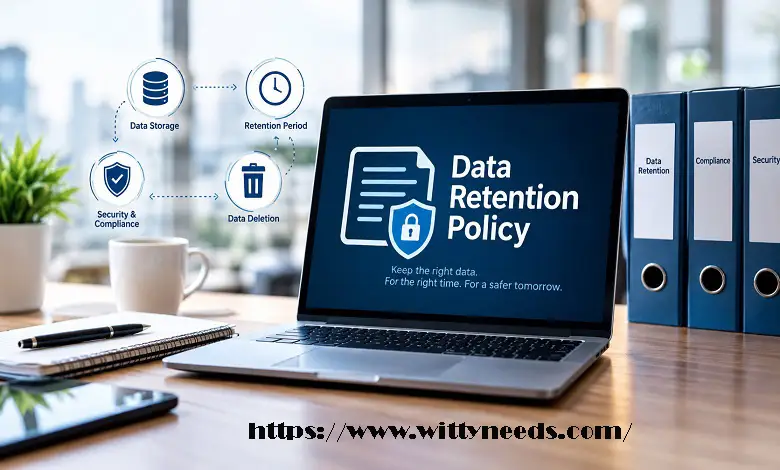
A data retention policy defines how long an organization keeps information, why it needs that information, and when records should be securely deleted or anonymized. Understanding what is a data retention policy is essential for businesses that want to protect sensitive information, manage storage costs, meet applicable legal requirements, and maintain reliable records.
Every organization handles information throughout its operations. Customer details, employee files, financial statements, contracts, emails, website logs, and transaction histories all have different purposes and retention requirements. Keeping everything indefinitely can increase security risks and create unnecessary costs, while deleting records too early can disrupt business operations or cause compliance problems.
A well-designed data retention policy provides a consistent framework for managing information from creation to final disposal. It identifies which records must be preserved, establishes appropriate retention periods, assigns responsibilities, and explains how exceptions should be handled.
This guide covers the meaning of a data retention policy, its key benefits, practical examples, recommended components, implementation steps, and common mistakes to avoid.
What Is a Data Retention Policy?
A data retention policy is a formal document that establishes rules for storing, maintaining, reviewing, archiving, and disposing of an organization’s information. It specifies the business purpose of each record category, the period for which information should be retained, and the conditions under which it should be deleted or anonymized.
The policy can apply to digital records and physical documents, including:
- Customer and supplier information
- Employee and recruitment records
- Invoices, receipts, and financial statements
- Contracts, agreements, and legal correspondence
- Emails, internal communications, and business documents
- Website analytics, application logs, and system records
- Databases, archived files, and backup copies
Not every record requires the same retention period. A company may need to preserve financial documents to meet accounting obligations while deleting outdated marketing information once it is no longer necessary. Similarly, technical logs may need to remain available for a defined period to support security investigations and troubleshooting.
A data retention policy documents these decisions and explains how they will be applied consistently. It should also establish who approves retention requirements, how scheduled reviews take place, and what happens when a record is subject to a legal hold.
Why Is a Data Retention Policy Important?
A documented retention policy helps organizations manage information more responsibly. Without clear rules, departments may store unnecessary files, delete important records prematurely, or follow inconsistent practices that increase operational and compliance risks.
The following benefits explain why data retention deserves attention.
1. Helps Support Regulatory Compliance
Businesses may be subject to laws and regulations governing financial records, employment information, personal data, healthcare documentation, and industry-specific records. A retention policy helps identify the requirements that apply to each category and documents the reasoning behind retention decisions.
For example, the UK GDPR includes a storage limitation principle requiring personal data to be kept in an identifiable form for no longer than necessary for its processing purposes, subject to applicable exceptions.
Requirements differ by jurisdiction, industry, record type, and business circumstances. A policy should therefore be reviewed against the organization’s actual legal obligations rather than copied from another company’s retention schedule.
2. Improves Data Security and Privacy
Information that no longer serves a legitimate purpose can still create risk if it remains stored and accessible. Outdated customer records, forgotten user accounts, and unnecessary document copies may expose sensitive information if a system is compromised.
A data retention policy reduces this exposure by establishing when information should be removed, who can access retained records, and how sensitive data should be protected.
Reducing unnecessary data also makes it easier to understand what information an organization holds and where additional security controls are needed.
3. Reduces Storage and Maintenance Costs
Storing large volumes of unnecessary information can increase cloud storage expenses, backup requirements, administrative work, and system maintenance costs.
A clear retention schedule helps organizations identify records that can be deleted or moved to appropriate archival storage. It can also reduce the time employees spend managing outdated documents and locating relevant information.
The goal is not to delete useful records simply to save money. Instead, businesses should preserve information that has a valid purpose and remove records that no longer need to be retained.
4. Supports Better Record Management
When employees follow consistent retention rules, important records are easier to organize, retrieve, and maintain. Teams can identify the correct versions of documents, understand how long information must remain available, and avoid keeping multiple unnecessary copies.
This is particularly useful for organizations that manage large volumes of contracts, customer interactions, financial transactions, or internal communications.
5. Helps Manage Legal and Operational Risks
Some records may be required to resolve disputes, respond to audits, investigate security incidents, or demonstrate that a business followed its procedures.
A retention policy helps ensure that important evidence remains available for the appropriate period. It should also establish a legal-hold process that suspends routine deletion when information may be relevant to litigation, an investigation, or another formal matter.
What Should a Data Retention Policy Include?
An effective data retention policy should be specific enough for employees and systems to follow. A general statement about keeping records safely is not sufficient; the document needs clear rules, responsibilities, and disposal procedures.
The following components provide a practical foundation.
1. Purpose and Scope
Explain why the policy exists and which parts of the organization must follow it. Define whether it covers employees, contractors, departments, subsidiaries, third-party service providers, and all relevant information systems.
The scope should include digital information and physical records wherever applicable.
2. Data Categories and Ownership
Identify the types of information the organization collects, creates, or receives. For each category, record its purpose, storage location, sensitivity, and responsible owner.
For example, the finance team may own invoice records, while human resources manages employee files. IT may be responsible for system logs and technical backups.
Clear ownership makes it easier to review retention periods and resolve questions about whether information is still needed.
3. Retention Periods and Their Justification
Specify how long each category of information should be retained and explain the reason for that period.
Retention decisions may depend on statutory requirements, contractual obligations, business needs, security requirements, or the period during which a record may reasonably be needed to resolve a claim.
Avoid using one retention period for every type of information. Each period should have a defensible basis and be reviewed when laws, business processes, or risks change.
4. Access and Security Controls
Describe how retained information should be protected. Depending on the data involved, controls may include role-based access, encryption, secure storage, access logs, and restrictions on copying or sharing records.
Retention does not remove the need for security. Information that must be preserved for several years still needs appropriate protection throughout that period.
5. Data Disposal and Optimization
Explain how information should be removed when its retention period ends and no valid reason for continued storage remains.
Digital records may require secure deletion, while paper documents may need confidential shredding or an approved destruction service. Where appropriate, information may be anonymized so individuals can no longer be identified.
The policy should address copies, exports, archived records, and backups. It should also distinguish between deleting data from an active system and ensuring that remaining copies are no longer accessible or usable.
6. Legal Holds and Exceptions
Routine deletion must not destroy records that need to be preserved for litigation, audits, investigations, or other applicable obligations.
The policy should identify who can authorize a legal hold, how affected records are identified, and how the hold is released. Normal deletion should resume only after the responsible person confirms that the hold no longer applies.
7. Monitoring, Reviews, and Accountability
Specify who monitors compliance, how often the policy is reviewed, and how exceptions or disposal failures are documented.
Depending on the organization’s size and risk profile, reviews may involve internal audits, automated retention reports, sample checks, or periodic confirmation from data owners.
Data Retention Policy Examples
The right retention period depends on the type of information, its purpose, and the rules applicable to the organization. These examples illustrate how a policy might work; they are not universal legal retention requirements.
| Data category | Example retention approach | Key consideration |
| Customer account records | Retain while the account is active, then review under an approved schedule | Some records may need to remain for legitimate post-account obligations |
| Financial documents | Follow applicable accounting, tax, and audit requirements | Requirements vary by jurisdiction and document type |
| Employee records | Retain according to employment, payroll, pension, and legal obligations | Different documents may require different periods |
| Recruitment records | Establish a documented period based on recruitment needs and potential claims | Avoid keeping unsuccessful applicants’ information indefinitely |
| Website and application logs | Retain for a defined operational or security purpose | Balance troubleshooting needs, privacy, and storage costs |
| Marketing contact data | Review when consent, preferences, or the business purpose changes | Honor applicable objections and deletion requirements |
| Backup files | Follow a documented backup lifecycle and deletion process | Deleted records may persist in backups until scheduled expiry |
These examples demonstrate why a single blanket retention period is rarely appropriate. A business should create a schedule that distinguishes record types and documents the reason for each decision.
How to Create a Data Retention Policy
Developing a useful policy requires more than choosing dates. Organizations need to understand their information, identify applicable obligations, assign ownership, and establish a process that works in everyday operations.
Step 1: Inventory the Information You Hold
Start by identifying the information collected, created, received, or stored across the organization. Include cloud applications, email platforms, shared drives, databases, paper archives, third-party services, and backup systems.
Record the information category, purpose, location, owner, sensitivity, and relevant systems. This inventory provides the foundation for deciding what should be retained and what can be removed.
Step 2: Identify Legal and Business Requirements
Consult the relevant legal, compliance, finance, HR, security, and operational teams to establish which records must be preserved and why.
Check applicable laws, regulatory guidance, contracts, audit requirements, and legitimate business needs. Where the rules are unclear or the consequences of an incorrect decision could be significant, seek qualified legal or compliance advice.
Step 3: Establish Appropriate Retention Periods
Assign a retention period to each category based on documented requirements and purpose.
For personal information, consider whether the original purpose still applies, whether the information remains necessary, and whether it can be anonymized or deleted sooner. For regulated records, confirm the relevant statutory requirements before setting a schedule.
Avoid retaining information simply because it might be useful someday.
Step 4: Document Responsibilities and Procedures
Write the policy in clear language that employees can understand and follow. Identify who approves retention periods, who reviews records, who authorizes exceptions, and who is responsible for disposal.
Create a retention schedule that translates the policy into operational rules. The schedule should identify record categories, retention periods, the event that starts the retention clock, and the required action at expiry.
Step 5: Implement Retention and Disposal Controls
Where possible, configure systems to label records, flag upcoming expiry dates, and trigger review or deletion workflows.
Automation can reduce manual work, but it needs appropriate safeguards. Before deleting records automatically, confirm that retention rules are correct and that legal holds, audit needs, and relevant exceptions are accounted for.
Test the process with a limited set of records before applying it across the organization.
Step 6: Train Employees and Communicate the Policy
Explain the policy to employees who create, access, or manage organizational information. Training should cover where records belong, how retention periods work, how to handle deletion requests, and whom to contact when a record must be preserved.
Employees should also understand that deleting information outside the approved process can create serious problems, particularly when an audit, dispute, or investigation is underway.
Step 7: Review and Improve the Policy
Review the policy periodically and when important changes occur, such as new regulations, new software, acquisitions, changes in business processes, or security incidents.
Monitor whether records are being deleted on schedule, whether exceptions are documented, and whether unnecessary information is accumulating. Update the policy and retention schedule when the evidence shows that existing rules are no longer appropriate.
What Is the Difference Between a Data Retention Policy and a Retention Schedule?
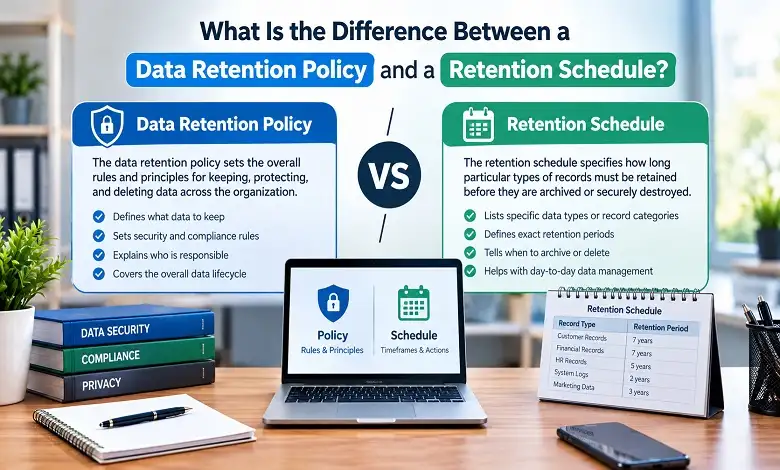
A data retention policy and a data retention schedule are closely related, but they serve different purposes.
A data retention policy establishes the overall principles, responsibilities, and procedures for managing information. It explains why records are retained, who is accountable, and how storage, review, and disposal should be handled.
A data retention schedule provides the specific operational details for individual record categories. It lists how long each type of record should be kept, what event starts the retention period, and what should happen when that period ends.
For example, a policy may require the organization to retain financial records according to applicable legal requirements. The schedule then identifies the relevant financial record categories and specifies their approved retention periods.
The policy provides the framework; the schedule turns that framework into actionable instructions. Both should be maintained together and updated when requirements change.
Common Data Retention Policy Mistakes to Avoid
Even a well-written policy can fail if its rules are unclear, outdated, or difficult to implement. Watch for these common problems.
Keeping everything indefinitely: Retaining every record without a valid purpose increases exposure and makes information harder to manage. Establish justified retention periods and review records when they are no longer needed.
Using the same period for every record: Customer data, contracts, payroll files, and system logs have different purposes and obligations. Create separate categories and document the reasoning behind each period.
Ignoring backups and duplicate copies: Removing a file from a shared drive does not necessarily remove copies from email, exports, archives, or backup systems. Define how each storage location is handled.
Failing to account for legal holds: Automated deletion can destroy information that must be preserved. Establish a process for suspending deletion and documenting the release of a hold.
Relying entirely on manual processes: Employees may overlook expiry dates or forget to remove outdated information. Use automated reminders and deletion workflows where appropriate, with human oversight for exceptions.
Not reviewing the policy: Business operations and legal requirements change over time. Schedule regular reviews and make updates when material changes occur.
Failing to assign ownership: If nobody is accountable for a record category, retention decisions may be delayed or applied inconsistently. Assign a responsible owner to each major information category.
Data Retention Policy Best Practices
Organizations can improve their retention processes by following a few consistent practices.
- Document the reason for retention. Every retention period should have a clear business, legal, operational, or other justified basis.
- Collect and retain only necessary information. Avoid keeping personal or confidential data without a continuing purpose.
- Use a centralized retention schedule. Give record owners and relevant employees access to the approved rules.
- Automate routine tasks carefully. Use expiry notifications and deletion workflows, but account for legal holds and exceptions.
- Protect records throughout their life-cycle. Apply appropriate access restrictions and security controls while information is retained.
- Keep evidence of important actions. Document approvals, exceptions, reviews, and disposal activities where appropriate.
- Coordinate with service providers. Understand how cloud vendors and other processors store, return, delete, or retain information.
- Review the policy regularly. Confirm that retention periods remain suitable as the business and its obligations evolve.
These practices help turn a written policy into a reliable information management process.
Frequently Asked Questions About Data Retention Policies
Q: What is a data retention policy in simple terms?
A: A data retention policy is a set of rules explaining what information an organization keeps, why it keeps it, how long it retains it, and when it should be securely deleted or anonymized.
Q: How long should a company retain data?
A: There is no single retention period that applies to all business information. The appropriate period depends on the record type, its purpose, applicable laws, contractual obligations, and legitimate operational needs. Organizations should document and periodically review their decisions.
Q: Is a data retention policy legally required?
A: Requirements vary by jurisdiction, industry, and the information being processed. Certain laws require organizations to document retention practices or establish specific record keeping procedures. Even where a formal written policy is not expressly required, organizations may still need to justify how long they retain personal or regulated information.
Q: What happens when a data retention period expires?
A: When a record reaches the end of its approved retention period, the organization should review whether a valid reason for continued storage remains. If not, the record should be securely deleted or anonymized according to the approved procedure. A legal hold or another applicable obligation may require retention beyond the usual date.
Q: Who is responsible for a data retention policy?
A: Responsibility usually involves several teams. Management approves the policy, legal or compliance specialists help identify applicable obligations, IT implements technical controls, and record owners oversee their information categories. Employees are responsible for following the procedures relevant to their work.
Q: What is the difference between data retention and data backup?
A: Data retention determines how long information should be kept and when it should be disposed of. Data backup creates recoverable copies to support restoration after data loss, system failure, or another incident. Backups need their own life-cycle rules and should align with the organization’s retention and deletion requirements.
Q: Can a company keep data after a customer closes an account?
A: Sometimes. A company may need to retain certain records to meet legal obligations, resolve disputes, complete transactions, or satisfy other justified requirements. However, closing an account does not automatically justify keeping every associated detail. Each category should be reviewed under the applicable retention rules.
Conclusion
A data retention policy helps organizations manage information throughout its life-cycle by defining what to keep, why it is needed, how long it should remain available, and when it should be securely disposed of. It supports consistent record keeping, reduces unnecessary data exposure, and helps businesses manage their legal, operational, and security responsibilities.
An effective policy should include clear retention periods, documented justifications, assigned responsibilities, secure disposal procedures, and safeguards for legal holds and other exceptions. Organizations should also maintain a practical retention schedule, use automation where appropriate, and review their rules as requirements change.
The most important principle is straightforward: retain information for as long as there is a justified reason to keep it, and dispose of it safely when that reason no longer exists. By applying this principle consistently, businesses can build a more secure, organized, and accountable approach to data management.