
The telecommunications industry has evolved rapidly over the last few decades. From traditional landlines to VoIP and cloud-based communication systems, businesses and consumers now have more choices than ever. One important concept that played a major role in telecom competition and cost reduction is carrier pre select, also known as carrier pre-selection (CPS).
If you have ever wondered “what is carrier pre select?”, this detailed guide explains everything in simple language. You will learn how carrier pre select works, its benefits, limitations, business applications, and why it has become important in the telecom sector.
What Is Carrier Pre Select?
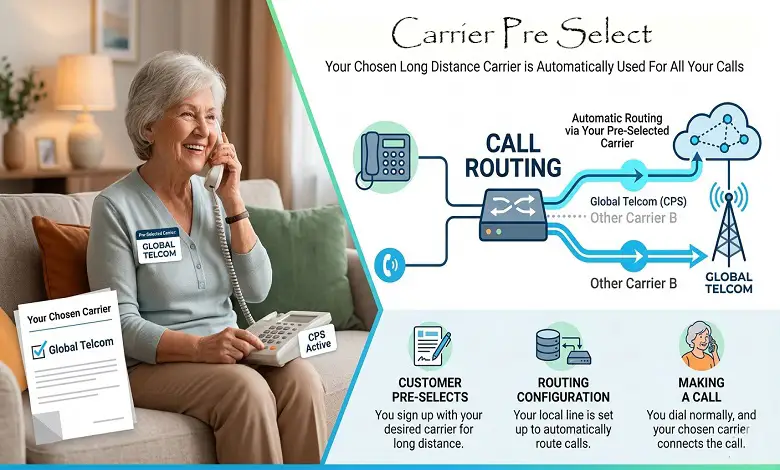
Carrier pre select is a telecommunications service that allows a customer to choose a preferred phone carrier for outgoing calls without manually dialling access codes every time. Once activated, calls are automatically routed through the selected telecom provider.
In simple terms, carrier pre select lets users use another company’s network for calls while still keeping their existing telephone line.
For example:
- Your telephone line may still be provided by a major network operator.
- However, your national or international calls can automatically go through a cheaper carrier.
- You do not need special equipment or manual dialling prefixes.
This system became extremely popular when telecom markets opened to competition, and customers started searching for lower calling costs.
Understanding Carrier Pre-Selection (CPS)
Carrier Pre-Selection, commonly abbreviated as CPS, was introduced to increase competition in telecommunications markets. It allowed alternative telecom companies to offer calling services using existing infrastructure owned by larger operators.
Before CPS existed, customers usually had only one telephone provider. Switching providers often meant changing lines, equipment, or numbers. Carrier pre select changed this by separating:
- Line rental provider
- Call routing provider
As a result, customers gained more freedom and flexibility.
How Does Carrier Pre Select Work?
Carrier pre select works through automatic call routing at the telephone exchange level. When a user places a call, the exchange identifies the preferred carrier associated with that phone line and routes the call through the chosen network.
Step-by-Step Process
Here is a simplified explanation of the process:
- A customer subscribes to a CPS provider.
- The local telecom exchange stores the selected carrier information.
- When the customer makes a call, the exchange automatically routes the call through the preferred carrier.
- The user does not need to enter any extra digits or codes.
This process is seamless and invisible to the end user.
Why Was Carrier Pre Select Introduced?
Carrier pre select was mainly introduced to:
- Increase telecom competition
- Reduce call costs
- Give consumers more options
- Encourage innovation among telecom providers
Regulators in many countries required dominant telecom operators to support CPS so that smaller providers could compete fairly.
Without carrier pre select, large telecom companies would have maintained complete control over both phone lines and call services.
Main Features of Carrier Pre Select
Carrier pre select offers several useful features that made it attractive for businesses and residential customers.
1. Automatic Call Routing
The biggest advantage is automation. Calls are routed automatically without needing manual intervention.
2. No Special Equipment Needed
Users can continue using:
- Existing telephone, Existing phone numbers
- Existing lines, Existing PBX systems
No hardware upgrades are usually required.
3. Lower Call Costs
Many businesses adopted CPS to reduce:
- International call expenses
- Long-distance charges
- Mobile call rates
4. Flexibility
Customers can choose different carriers depending on pricing or service quality.
5. Easy Setup
Implementation is typically managed by the telecom provider and exchange operator.
Carrier Pre Select vs Call-by-Call Routing
Many people confuse carrier pre select with call-by-call routing, but they are different.
| Feature | Carrier Pre Select | Call-by-Call Routing |
| Automatic routing | Yes | No |
| Manual code needed | No | Yes |
| User convenience | High | Medium |
| Setup process | One-time | Every call |
| Common business use | Very common | Less common |
With call-by-call routing, users must dial a special prefix before every call. Carrier pre select eliminates this step by permanently assigning a preferred carrier.
Benefits of Carrier Pre Select
Reduced Telecom Costs
One of the main reasons businesses adopted CPS was cost savings. Alternative carriers often offered cheaper rates than incumbent telecom providers.
Businesses making frequent international or long-distance calls benefited the most.
Improved Competition
Carrier pre select encouraged market competition. New telecom providers could enter the market without building an entire nationwide infrastructure network.
Better Customer Choice
Customers gained the ability to select providers based on:
- Price
- Service quality
- Customer support
- International coverage
No Service Disruption
Since the existing phone line remains active, users experience minimal disruption during setup.
Efficient Call Management
Businesses could optimize telecom expenses without replacing existing communication systems.
Business Use of Carrier Pre Select
Carrier pre select became particularly important for businesses with large call volumes.
Common Business Applications
Businesses used CPS for:
- Customer service centers
- International offices
- Sales departments
- Corporate communication systems
- Multi-location enterprises
Large companies often negotiated lower call rates with CPS providers.
PBX Compatibility
Carrier pre select worked well with PBX telephone systems because it did not require extensive reprogramming.
This made adoption faster and more affordable.
Carrier Pre Select and Least Cost Routing (LCR)
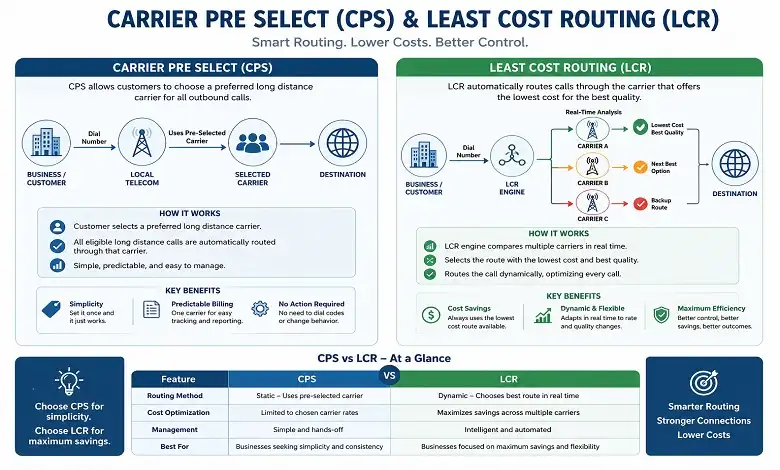
Carrier pre select is closely related to least cost routing (LCR).
Least cost routing means selecting the cheapest available telecom route for calls. CPS helps automate this process by directing calls through cost-effective carriers.
For example:
- International calls may use Carrier A
- Mobile calls may use Carrier B
- National calls may use Carrier C
This approach significantly reduces communication costs.
Is Carrier Pre Select Still Relevant Today?
Although modern telecom technologies like VoIP and SIP trunking have reduced reliance on traditional CPS systems, carrier pre select remains relevant in some situations.
Areas Where CPS Is Still Used
- Legacy telecom systems
- Traditional landline businesses
- Rural telecom infrastructure
- Government telecom networks
- Hybrid communication environments
Many organizations continue using CPS because it offers stable and predictable call routing.
Carrier Pre Select in Different Countries
Carrier pre select regulations differ across countries.
United Kingdom
In the UK, CPS became highly popular after telecom deregulation. It allowed customers to choose alternative providers while keeping BT lines.
Germany
Germany widely implemented preselection services, especially for long-distance and international calling.
European Union
Several EU countries supported CPS as part of telecom competition policies.
United States
The US used similar systems involving interexchange carriers and long-distance provider selection.
Challenges and Limitations of Carrier Pre Select
Despite its advantages, carrier pre select also had limitations.
Limited to Voice Calls: Traditional CPS mainly focused on voice traffic rather than internet or data services.
Dependency on Existing Infrastructure: Alternative providers still relied heavily on incumbent telecom networks.
Complex Billing: Some customers received separate bills for:
- Line rental
- Call charges
- Additional telecom services
Reduced Relevance in the VoIP Era
Modern VoIP technology offers greater flexibility than traditional CPS systems.
Carrier Pre Select vs VoIP
Many businesses today compare carrier pre select with Voice over Internet Protocol (VoIP).
| Feature | Carrier Pre Select | VoIP |
| Uses internet | No | Yes |
| Requires traditional line | Yes | Not always |
| Setup complexity | Low | Medium |
| Modern features | Limited | Advanced |
| International call savings | Good | Excellent |
| Scalability | Moderate | High |
VoIP is generally more advanced, but CPS can still be useful where stable landline infrastructure already exists.
Advantages of Carrier Pre Select for Small Businesses
Small businesses especially benefited from CPS because it allowed them to reduce costs without investing heavily in new telecom systems.
Key Advantages
- Lower monthly communication costs
- No major hardware upgrades
- Reliable voice connectivity
- Easy implementation
- Better control over telecom spending
For businesses operating on tight budgets, CPS provided a practical solution.
Security and Reliability of Carrier Pre Select
Carrier pre select is generally considered reliable because routing occurs within established telecom infrastructure.
Reliability Factors
- Stable landline networks
- Managed routing systems
- Telecom-grade infrastructure
- Minimal dependence on internet connectivity
This reliability made CPS attractive for organizations requiring uninterrupted voice communication.
How to Choose a Carrier Pre Select Provider
If you are considering CPS services, evaluate providers based on several factors.
Important Considerations
Compare:
- Local call rates
- International charges
- Mobile call pricing
Network Reliability
Choose providers with strong infrastructure and uptime guarantees.
Customer Support
Reliable support is essential for troubleshooting and billing issues.
Contract Terms
Review:
- Minimum contract periods
- Hidden charges
- Service-level agreements
Coverage Areas
Ensure the provider supports your required destinations.
Future of Carrier Pre Select
The telecom industry continues evolving toward cloud communications, VoIP, and unified communication platforms. However, carrier pre select still serves niche markets and legacy systems.
Future Trends
- Integration with SIP systems
- Hybrid telecom environments
- Continued use in regulated industries
- Support for transitional telecom infrastructure
While CPS may no longer dominate the telecom landscape, its role in telecom history remains significant.
Key Takeaways About Carrier Pre Select
Here are the most important things to remember:
- Carrier pre select allows automatic routing of calls through a preferred telecom provider.
- Users can keep existing phone lines and equipment.
- CPS helps reduce calling costs.
- It improved telecom market competition.
- Businesses widely adopted CPS for least cost routing.
- Modern VoIP systems have reduced CPS popularity, but it remains useful in certain sectors.
Final Thoughts
Carrier pre select played a major role in transforming the telecommunications industry. It gave businesses and consumers more control, increased competition among telecom providers, and significantly reduced communication costs.
Although newer technologies such as VoIP and cloud telephony now dominate the market, carrier pre select remains an important concept in telecom history and continues to be used in specific environments.
Understanding how carrier pre select works helps businesses make better decisions about communication infrastructure, cost management, and telecom services. Whether you are researching telecom systems, optimizing business communication, or simply learning about telecommunications technology, carrier pre select is a concept worth understanding in depth.