

Understanding the value of a business is one of the most important aspects of strategic decision-making. Whether a company is preparing for a sale, seeking investment, planning for succession, or resolving shareholder disputes, knowing its true worth can significantly influence the outcome. Before the valuation process begins, however, a critical document must be prepared: the valuation proposal.
A well-crafted business valuation proposal serves as the foundation for a successful valuation engagement. It outlines the purpose of the valuation, defines the scope of work, explains the valuation methodology, identifies required information, and establishes expectations regarding timelines, deliverables, and fees.
For business owners, investors, lenders, and valuation professionals, a detailed valuation proposal provides clarity and transparency throughout the valuation process. It helps ensure that all parties understand the objectives of the engagement and how the final valuation report will be developed.
This comprehensive guide explains everything you need to know about creating a professional business valuation proposal, including its key components, benefits, best practices, and common mistakes to avoid.
What Is a Valuation Proposal?
A valuation proposal is a formal document prepared by a valuation consultant, financial advisor, CPA, or business appraisal professional that outlines how a business valuation engagement will be conducted.
The proposal serves as both a project road map and an engagement agreement. It explains the purpose of the valuation, the methodology that will be used, the information required from the client, the expected deliverables, and the associated costs.
A professional valuation proposal typically answers several important questions:
- Why is the valuation being performed?
- What is the scope of the valuation engagement?
- Which valuation methods will be used?
- What information must the client provide?
- How long will the valuation process take?
- What deliverables will be provided?
- What fees will be charged?
By clearly addressing these questions, a valuation proposal helps establish trust between the client and the valuation professional while reducing the likelihood of misunderstandings.
What Is a Business Valuation Proposal?
A business valuation proposal is a specialized valuation proposal focused on determining the fair market value of a company. It provides a detailed overview of how the business valuation services will be performed and what the client can expect during the engagement.
Unlike a simple quote or service estimate, a business valuation proposal includes detailed information about the valuation process, assumptions, methodologies, and reporting standards that will be followed.
Business valuation proposals are commonly used for:
- Business sales
- Mergers and acquisitions
- Investor funding rounds
- Financial reporting
- Estate and succession planning
- Shareholder disputes
- Tax compliance
- Litigation support
Because every valuation engagement is unique, the proposal should be tailored to the specific objectives of the client.
Why a Business Valuation Proposal Is Important
Many business owners focus solely on the final valuation report, but the proposal itself plays a crucial role in the success of the engagement.
Establishes Clear Expectations
One of the primary benefits of a valuation proposal is that it establishes clear expectations from the beginning. Both the client and the valuation professional understand what work will be performed, what information is required, and what deliverables will be produced.
This clarity reduces confusion and helps prevent disputes later in the process.
Defines the Scope of Work
The scope of work is one of the most important sections of a business valuation proposal. It outlines the specific tasks that will be completed and identifies any services that are excluded from the engagement.
A clearly defined scope helps avoid scope creep and ensures the valuation project remains on track.
Improves Transparency
Business valuations often involve complex financial analysis and technical methodologies. A valuation proposal explains these concepts in a way that clients can understand, helping them feel more confident in the valuation process.
Provides Legal and Professional Protection
The proposal serves as a formal agreement that documents responsibilities, timelines, fees, assumptions, and limitations. This provides protection for both parties and reduces the risk of misunderstandings.
Demonstrates Expertise
A detailed and professional business valuation proposal showcases the valuation consultant’s experience, methodology, and professionalism. Clients are more likely to trust a provider who presents a clear and well-organized proposal.
When Do You Need a Valuation Proposal?
Businesses seek valuation services for many reasons. Regardless of the objective, a valuation proposal provides the framework needed to conduct an accurate valuation analysis.
Selling a Business
When preparing to sell a company, business owners need an objective assessment of value. A valuation proposal explains how the business’s worth will be determined and what factors will influence the final valuation.
A professional company valuation can help sellers establish a realistic asking price and negotiate with confidence.
Mergers and Acquisitions
Buyers and sellers rely on business valuation services during mergers and acquisitions to ensure that transactions are based on fair market value.
A valuation proposal outlines how the valuation consultant will analyze the target company and determine an appropriate valuation range.
Raising Investment Capital
Investors often require a business valuation before providing funding. The valuation helps determine ownership percentages and supports investment negotiations.
A detailed valuation proposal provides transparency regarding the methods used to estimate business value.
Succession and Estate Planning
Business owners preparing for retirement or ownership transfer frequently require a valuation to support succession planning decisions.
A valuation proposal helps define the purpose and scope of the valuation engagement while ensuring all ownership interests are properly considered.
Shareholder Disputes
Disputes among shareholders or business partners often require an independent valuation to establish fair value.
A professional business valuation proposal provides a neutral framework for conducting the valuation process objectively.
Key Components of a Business Valuation Proposal
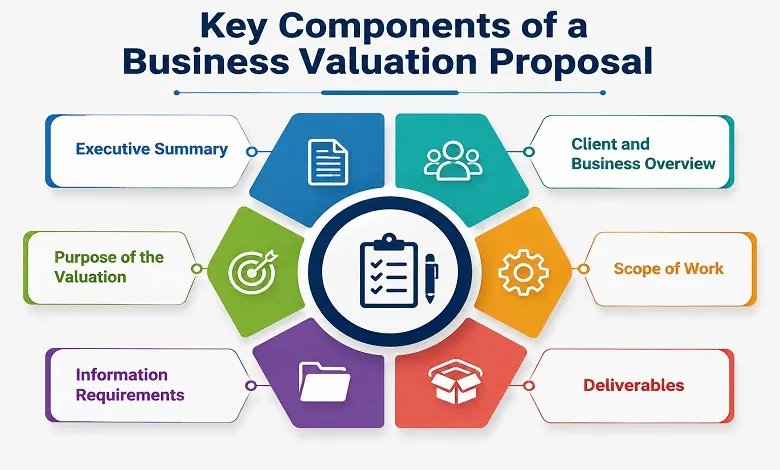
A professional business valuation proposal should include several essential sections that clearly define the valuation engagement and establish expectations between the client and the valuation consultant.
Executive Summary
The executive summary provides a concise overview of the valuation engagement. It summarizes the purpose of the valuation, the proposed methodology, the scope of work, estimated timeline, and expected deliverables. This section allows decision-makers to quickly understand the proposal without reading the entire document.
Client and Business Overview
Before determining the value of a company, valuation professionals must understand the business itself. This section typically includes information about the company’s history, industry, products and services, ownership structure, target market, and competitive position.
Providing background information helps the valuation consultant identify key value drivers and potential risks that may affect the final valuation conclusion.
Purpose of the Valuation
Clearly defining the purpose of the valuation is critical because it influences the valuation methodology, assumptions, and reporting requirements.
Common purposes include:
- Determining fair market value
- Preparing for a business sale
- Raising investment capital
- Mergers and acquisitions
- Estate planning
- Shareholder buyouts
- Tax reporting
- Litigation support
A business valuation proposal should explain why the valuation is being conducted and how the results will be used.
Scope of Work
The scope of work outlines the specific services included in the valuation engagement. Typical activities may include:
- Financial statement analysis
- Industry research
- Market analysis
- Management interviews
- Risk assessment
- Valuation modeling
- Business appraisal
- Final report preparation
The proposal should also identify any exclusions to prevent misunderstandings later in the project.
Information Requirements
A valuation consultant relies on accurate information to conduct a reliable valuation analysis. The proposal should include a list of required documents such as:
- Historical financial statements
- Tax returns
- Cash flow reports
- Business plans
- Customer concentration reports
- Organizational charts
- Shareholder agreements
- Contracts and leases
The faster the information is provided, the more efficiently the valuation process can proceed.
Deliverables
The business valuation proposal should clearly describe what the client will receive at the conclusion of the engagement.
Common deliverables include:
- Comprehensive valuation report
- Executive summary
- Financial models
- Supporting schedules
- Presentation materials
Clearly defining deliverables helps manage expectations and ensures transparency throughout the engagement.
How to Write a Business Valuation Proposal
Creating an effective valuation proposal requires a balance between technical expertise and clear communication.
Understand the Client’s Objectives
Every valuation engagement begins with understanding why the client needs a valuation. A business owner preparing for a sale will have different objectives than an investor evaluating a potential acquisition.
Tailoring the proposal to the client’s specific needs improves its effectiveness and demonstrates professionalism.
Define the Scope Clearly
One of the most common reasons valuation engagements encounter problems is an unclear scope of work. Clearly outlining responsibilities, deliverables, and limitations helps avoid misunderstandings and keeps the project on track.
Explain the Valuation Methodology
Clients may not be familiar with valuation techniques. A good business valuation proposal explains the methodology in straightforward language so clients understand how their company’s value will be determined.
Establish Realistic Timelines
Valuation projects require detailed financial analysis, market research, and data verification. Setting realistic deadlines helps ensure quality and prevents unnecessary pressure on either party.
Include Transparent Pricing
Business owners appreciate transparency. Clearly explain whether the engagement uses fixed fees, hourly billing, or a retainer structure.
A transparent fee structure builds trust and reduces the likelihood of disputes.
Common Business Valuation Methods
A professional valuation proposal should explain the valuation methods expected to be used during the engagement.
Income Approach
The income approach values a business based on its expected future earnings and cash flows. This method is particularly useful for profitable businesses with predictable revenue streams.
One of the most widely used techniques under this approach is Discounted Cash Flow (DCF) analysis, which estimates the present value of future cash flows.
Market Approach
The market approach estimates value by comparing the company to similar businesses that have recently been sold or publicly traded.
Common valuation metrics include:
- Revenue multiples
- EBITDA multiples
- Earnings multiples
This approach helps determine what the market is willing to pay for similar companies.
Asset Approach
The asset approach determines value by calculating total assets minus total liabilities.
This method is often used for:
- Asset-intensive businesses
- Real estate companies
- Holding companies
- Liquidation scenarios
Most valuation professionals consider multiple approaches before reaching a final valuation conclusion.
Factors That Affect Business Valuation
Business valuation is influenced by numerous factors beyond revenue and profit.
Financial Performance
Strong financial performance generally leads to higher valuation multiples. Buyers and investors often focus on revenue growth, profitability, cash flow stability, and debt levels.
Industry Trends
Companies operating in growing industries may receive higher valuations than those in declining sectors. Industry outlook and market demand play significant roles in valuation analysis.
Customer Diversification
Businesses that rely heavily on a small number of customers may face valuation discounts due to concentration risk. A diversified customer base generally increases business value.
Management Strength
A strong management team that can operate independently of the owner often makes a company more attractive to buyers and investors.
Competitive Advantage
Businesses with unique products, strong brands, patents, trademarks, or proprietary technology may command premium valuations due to their competitive advantages.
Business Valuation Proposal Example
The following simplified example demonstrates how a business valuation proposal may be structured.
Client
ABC Manufacturing Ltd.
Purpose
Determine fair market value for a potential acquisition.
Scope of Work
- Review five years of financial statements
- Analyze industry conditions
- Conduct management interviews
- Apply income, market, and asset approaches
- Prepare a comprehensive valuation report
Deliverables
- Business valuation report
- Financial model
- Executive summary presentation
Timeline
Four weeks from receipt of all requested documents.
Fee
Fixed engagement fee of $7,500.
While actual proposals are typically much more detailed, this example illustrates the overall structure.
Best Practices for Writing a Valuation Proposal
Successful valuation proposals share several common characteristics.
Customize Every Proposal
Avoid relying solely on generic templates. Tailor the proposal to the client’s industry, objectives, and specific circumstances.
Use Clear Language
Although valuation work can be highly technical, proposals should be easy for clients to understand.
Focus on Client Benefits
Explain not only what services will be performed but also how the valuation will help the client make better business decisions.
Highlight Experience and Credentials
Clients want confidence that the valuation will be performed professionally. Include relevant qualifications, certifications, and experience when appropriate.
Set Realistic Expectations
Avoid making promises regarding valuation outcomes. The proposal should emphasize objectivity and independence.
Common Mistakes to Avoid
Several mistakes can reduce the effectiveness of a valuation proposal.
- Using generic templates without customization
- Failing to define the scope of work clearly
- Omitting key assumptions and limitations
- Setting unrealistic deadlines
- Providing vague deliverable descriptions
- Using excessive technical jargon
- Failing to explain the valuation methodology
Avoiding these mistakes can improve client satisfaction and contribute to a more successful engagement.
Final Thoughts
A well-prepared valuation proposal is much more than an administrative document. It serves as the foundation of the entire valuation process, helping business owners, investors, lenders, and stakeholders understand how a company’s value will be determined.
An effective business valuation proposal clearly defines the purpose of the engagement, outlines the scope of work, explains the valuation methodology, identifies required information, and establishes expectations regarding deliverables, timelines, and fees. By investing time in creating a detailed and professional proposal, valuation consultants can improve transparency, strengthen client relationships, and deliver more reliable valuation outcomes.
Whether the goal is a business sale, investment opportunity, merger, acquisition, succession plan, or shareholder dispute, a comprehensive valuation proposal provides the framework necessary for a successful valuation engagement and informed business decision-making.
FAQs:
Q: What is a valuation proposal?
A. A valuation proposal is a document that outlines how a valuation engagement will be conducted, including the scope of work, methodology, timeline, deliverables, and fees.
Q: What is a business valuation proposal?
A. A business valuation proposal specifically focuses on determining the value of a company and explains the process that will be used to perform the valuation.
Q: Why is a business valuation proposal important?
A. It establishes expectations, improves transparency, defines responsibilities, and serves as the foundation for a successful valuation engagement.
Q: How long does a business valuation take?
A. Most business valuation engagements take between two and six weeks, depending on the complexity of the business and the availability of information.
Q: What documents are needed for a business valuation?
A. Typical documents include financial statements, tax returns, business plans, customer data, shareholder agreements, and organizational charts.
Q: What valuation methods are most commonly used?
A. The income approach, market approach, and asset approach are the three most common valuation methodologies.
Q: Who prepares a valuation proposal?
A. Valuation consultants, CPAs, financial advisors, business appraisers, and valuation firms typically prepare valuation proposals.
Q: How much does a business valuation cost?
A. Costs vary depending on the size and complexity of the business. Some engagements are billed at fixed fees, while others use hourly rates.