
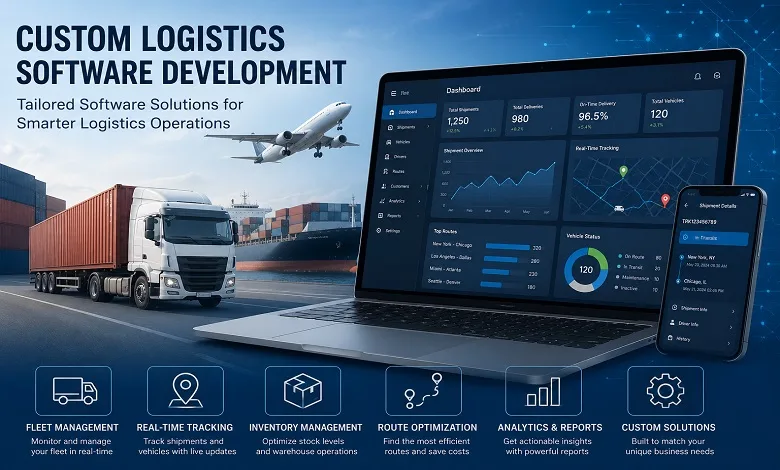
The logistics industry is becoming increasingly dependent on technology to manage shipments, transportation, warehouses, fleets, and customer expectations. As operations grow, businesses often find that standard software cannot fully accommodate their workflows or connect all of their systems efficiently. This is why many companies are turning to custom logistics software development to create solutions that match their specific operational needs.
From real-time shipment tracking and route planning to fleet management, warehouse operations, and automated reporting, a well-designed logistics platform can bring critical processes together in one place. Custom software development for logistics also allows businesses to integrate their existing tools and introduce features that are difficult to achieve with generic applications. For companies looking for greater flexibility, automation, and control, professional logistics custom software development services can provide a scalable technology foundation that supports both current operations and future growth.
What Is Custom Logistics Software Development?
Custom logistics software development is the process of designing and building software specifically for the needs of logistics, transportation, freight, warehousing, and supply chain businesses.
Unlike off-the-shelf software, a custom solution is designed around the company’s existing processes and operational goals. Businesses can choose the features, integrations, user interfaces, and automation they actually need instead of adapting their operations to a fixed platform.
A custom logistics platform may include:
- Transportation management
- Fleet management
- Shipment tracking
- Route planning
- Warehouse management
- Order management
- Driver management
- Customer portals
- Digital proof of delivery
- Reporting and analytics
- Third-party integration
The objective is not simply to create software with more features. It is to build a system that solves specific operational problems.
Why Do Logistics Companies Need Custom Software?
Modern logistics operations involve many moving parts. A single shipment may pass through order processing, inventory management, warehousing, transportation, tracking, delivery, and billing.
When each activity is handled through separate systems or manual processes, information can become fragmented. Employees may need to enter the same information multiple times, while managers may struggle to obtain an accurate view of ongoing operations.
Custom software development for logistics can connect these processes and create a centralized source of operational information.
This can help businesses:
- Reduce repetitive administrative work
- Improve shipment visibility
- Minimize manual data-entry errors
- Coordinate drivers and vehicles
- Improve delivery planning
- Monitor warehouse operations
- Provide better customer communication
- Generate useful business reports
Important Features of Logistics Software
The right features depend on the business model and operational requirements. However, several capabilities are common across modern logistics platforms.
Transportation Management
Transportation management helps companies plan and control the movement of goods.
Depending on the operation, the software may support shipment creation, dispatching, carrier management, load planning, delivery scheduling, transportation cost management, and shipment status tracking.
A centralized transportation system can make it easier for dispatch teams to coordinate daily operations.
Real-Time Shipment Tracking
Customers increasingly expect to know where their shipments are and when they are likely to arrive.
Custom software can integrate GPS, telematics, mobile applications, and mapping services to provide shipment visibility.
Users may be able to view:
- Current shipment status
- Vehicle location
- Estimated arrival time
- Delivery progress
- Driver information
- Proof of delivery
Real-time visibility can also reduce the number of routine status requests handled by customer service teams.
Route Optimization
Route planning directly affects fuel consumption, delivery times, driver productivity, and vehicle utilization.
A logistics platform can consider factors such as delivery locations, vehicle capacity, driver availability, delivery windows, traffic conditions, and shipment priority when creating routes.
For businesses managing many deliveries, better route planning can improve efficiency and reduce unnecessary mileage.
Fleet Management
Fleet management software can help companies monitor vehicles and maintain them more effectively.
Useful features may include:
- Vehicle location
- Mileage tracking
- Fuel monitoring
- Maintenance schedules
- Driver assignments
- Inspection records
- Service history
- Vehicle utilization
Having this information in one system allows fleet managers to identify maintenance requirements and monitor vehicle performance more effectively.
Warehouse Management
Warehouse operations are closely connected to transportation. Custom logistics software can link inventory and warehouse activities with orders and deliveries.
Common capabilities include:
- Inventory tracking
- Barcode scanning
- Receiving
- Picking and packing
- Stock transfers
- Warehouse location management
- Dispatch management
- Inventory alerts
This integration provides greater visibility into where goods are located and whether they are ready for shipment.
Benefits of Custom Logistics Software
Better Operational Efficiency
Automating repetitive tasks allows employees to spend less time on manual data entry and administrative activities.
Improved Visibility
A centralized system can provide managers with a clearer view of shipments, inventory, vehicles, orders, and delivery performance.
Fewer Manual Errors
When information is repeatedly entered into different systems, errors can occur. Automated data exchange can reduce duplicate entry and improve data consistency.
Greater Scalability
Custom software can be designed to support future expansion, including additional users, vehicles, warehouses, locations, and customers.
Improved Customer Experience
Tracking portals, automated notifications, estimated delivery times, and digital proof of delivery can make the shipping experience more transparent.
Better Business Decisions
Centralized data allows companies to analyze delivery performance, fleet utilization, shipment volumes, costs, and other operational metrics.
Custom Software Development for Logistics: When Is It Worth It?
Custom development is not necessary for every logistics company. Standard software can be a good option when a business has straightforward requirements.
However, custom development may be appropriate when a company:
- Has unique logistics workflows
- Needs specialized features
- Requires multiple system integrations
- Has outgrown an existing platform
- Needs greater control over operational data
- Requires specialized automation
- Plans significant business expansion
The decision should be based on business requirements, expected return on investment, and long-term technology needs.
Mobile Applications for Logistics
Many logistics activities happen outside the office, making mobile applications an important part of modern logistics technology.
A driver application can provide access to:
- Delivery assignments
- Navigation
- Customer information
- Delivery instructions
- Status updates
- Digital signatures
- Photos
- Proof of delivery
Customers can also use mobile applications to track shipments, receive notifications, and check delivery information.
The interface should be designed for the specific user. A driver working on the road, for example, needs a simple interface that allows common actions to be completed quickly.
Integrating Logistics Software with Other Systems
Logistics companies often rely on several software platforms. These may include ERP, CRM, accounting, e-commerce, warehouse, payment, mapping, GPS, and telematics systems.
API integration allows these systems to exchange information.
For example, an online order could automatically enter the logistics system. Once the order is processed and shipped, tracking information can be sent back to the customer’s account.
This reduces manual work and helps maintain consistent information across different platforms.
The Role of AI in Logistics Software
Artificial intelligence can support certain logistics operations when it is applied to a specific business need.
Potential applications include:
- Demand forecasting
- Delivery-time prediction
- Route optimization
- Inventory forecasting
- Predictive maintenance
- Automated customer support
- Shipment anomaly detection
For example, historical delivery information can be analyzed to identify patterns associated with late deliveries.
However, AI should not be treated as a requirement for every project. Businesses should first determine whether they have sufficient data and whether AI can deliver a measurable operational benefit.
Security in Custom Logistics Software
Logistics platforms can contain sensitive business and customer information. They may also handle employee accounts, location information, shipment details, and connections to external systems.
Security should therefore be considered throughout development.
Important practices may include:
- Role-based access controls
- Secure authentication
- Data encryption
- API security
- Activity logging
- Regular security testing
- Data backups
- Access monitoring
- Disaster recovery planning
The specific security requirements will depend on the type of information being processed and the organization’s regulatory obligations.
What Are Logistics Custom Software Development Services?
Logistics custom software development services cover the complete process of planning, developing, implementing, and maintaining software for logistics and transportation businesses.
These services may include:
- Business analysis
- Requirements gathering
- uni/UX design
- Software architecture
- Web development
- Mobile app development
- API development
- Third-party integration
- Database development
- Testing and quality assurance
- Cloud deployment
- Data migration
- Maintenance and support
A professional development process should begin with understanding the company’s business requirements rather than immediately writing code.
How the Development Process Works
1. Discovery
The development team studies the company’s workflows, problems, users, and objectives.
2. Requirements Planning
The required features, integrations, user roles, and technical requirements are documented.
3. uni/UX Design
Interfaces are designed around the needs of dispatchers, drivers, warehouse teams, administrators, and customers.
4. Development
Developers build the application’s front end, back end, databases, APIs, and other required components.
5. Testing
The system is tested for functionality, performance, security, compatibility, and integration problems.
6. Deployment
After testing and approval, the software is deployed to the production environment.
7. Maintenance
Post-launch support includes bug fixes, security updates, performance improvements, and future feature development.
How Much Does Custom Logistics Software Cost?
The cost of custom logistics software development depends heavily on the scope of the project.
Important cost factors include:
- Number of features
- Web and mobile requirements
- Integration complexity
- Number of users
- Real-time tracking requirements
- AI or analytics requirements
- Security requirements
- Cloud infrastructure
- uni/UX complexity
- Maintenance and support
A basic internal logistics application will have very different development requirements from an enterprise platform supporting multiple warehouses, fleets, mobile applications, real-time tracking, and numerous third-party integration.
For this reason, businesses should define their requirements before requesting a development estimate.
How to Choose a Logistics Software Development Company
Choosing the right development partner is important because logistics software often becomes part of daily business operations.
Before selecting a provider, consider:
Industry Experience
Look for experience with logistics, transportation, freight, fleet management, warehousing, or supply chain systems.
Technical Expertise
Review the company’s experience with APIs, cloud platforms, databases, mobile applications, security, and other technologies relevant to the project.
Integration Capability
Ask about previous experience connecting software with ERP, CRM, accounting, GPS, e-commerce, warehouse, and other third-party platforms.
Development Methodology
Understand how the provider handles requirements, milestones, testing, feedback, and changes during development.
Portfolio and Case Studies
Review previous projects and focus on the problems solved, functionality delivered, and measurable outcomes where information is available.
Post-Launch Support
Software requires ongoing maintenance. Confirm what support, updates, security patches, and future development services are available after launch.
Common Mistakes to Avoid
Businesses can reduce development risks by avoiding several common mistakes.
Building too many features at once: Start with the most important business requirements and expand later.
Ignoring end users: Drivers, dispatchers, warehouse employees, and managers should be involved when defining requirements.
Underestimating integration: Connecting multiple systems can require significant technical planning.
Skipping real-world testing: Software should be tested using realistic logistics scenarios before deployment.
Ignoring security: Security should be part of the architecture rather than an afterthought.
Failing to plan for growth: The system should be able to accommodate expected increases in users, transactions, locations, and data.
The Future of Logistics Software
Logistics technology continues to move toward connected and data-driven operations. Cloud computing, IoT devices, telematics, automation, predictive analytics, and artificial intelligence are creating new opportunities for logistics companies.
Future platforms are likely to focus more heavily on real-time visibility, automated decision-making, predictive insights, connected fleets, and seamless integration between different parts of the supply chain.
The most valuable technology, however, will not necessarily be the platform with the largest number of features. It will be the solution that addresses real operational problems and produces measurable business value.
Conclusion
Custom logistics software development can help logistics companies improve efficiency, visibility, and operational control. With the right features, integration, security, and scalable architecture, custom software development for logistics can address specific business challenges while supporting future growth.
Choosing experienced logistics custom software development services is therefore an important step toward creating a reliable technology solution that fits the company’s operations today while remaining flexible enough for tomorrow.
Frequently Asked Questions
Q: What is custom logistics software development?
A. It is the process of creating software specifically for the operational requirements of a logistics, transportation, freight, warehouse, or supply chain business.
Q: What can custom logistics software do?
A. It can support transportation management, fleet tracking, route planning, warehouse operations, shipment tracking, customer communication, reporting, billing, and third-party integration.
Q: Is custom logistics software better than off-the-shelf software?
A. Not always. Off-the-shelf software can work well for standard requirements. Custom software is more suitable when a company has specialized workflows, complex integration, or unique operational needs.
Q: Can logistics software integrate with existing business systems?
A. Yes. APIs and other integration technologies can connect logistics software with ERP, CRM, accounting, e-commerce, GPS, warehouse, payment, and mapping platforms.
Q: How long does custom logistics software development take?
A. The timeline depends on the number of features, integrations, platforms, users, testing requirements, and overall project complexity. A focused MVP will generally take less time than a large enterprise platform.
Q: Is AI necessary for logistics software?
A. No. AI can provide value for specific applications such as forecasting, route optimization, predictive maintenance, and automated support, but it should be introduced only when it addresses a genuine business need.
One thought on “Custom Logistics Software Development: A Complete Guide”
Comments are closed.