
Projects rarely go exactly as planned. Unexpected risks, cost increases, schedule delays, rework, and unforeseen work can affect even a carefully prepared project. A reserve management plan provides a structured way to prepare for these uncertainties without losing control of the project’s budget or schedule.
A reserve management plan explains how project reserves will be established, monitored, used, approved, and updated throughout the project lifecycle. It connects risk management with project cost and schedule control, helping project teams respond to uncertainty in a more organized way.
Whether you are managing a construction project, software implementation, business transformation, or another complex initiative, understanding how reserves work can make financial and risk planning more effective.
What Is a Reserve Management Plan?
A reserve management plan is a documented approach for managing money or time that has been set aside to address project uncertainty. It defines the types of reserves available, the risks or situations they can cover, who can authorize their use, and how reserve usage will be tracked.
The exact structure can vary between organizations and projects. The Project Management Institute defines a reserve as a provision in the project management plan intended to mitigate cost or schedule risks. PMI also distinguishes between management reserves and contingency reserves based on their purpose and how they are controlled.
A well-designed plan prevents reserves from becoming an unexplained extra budget. Instead, it makes them part of a transparent project control process.
Why Is a Reserve Management Plan Important?
Every project contains some level of uncertainty. Even when risks are identified during planning, their probability and financial or schedule impact may change as the project progresses.
A reserve management plan gives the project team a defined process for dealing with this uncertainty. It can help the team:
| Benefit | How it Helps |
| Manage uncertainty | Provides resources for eligible risks and unforeseen work |
| Protect the budget | Reduces the immediate impact of certain unexpected costs |
| Control schedule risk | Provides time reserves where appropriate |
| Improve transparency | Shows stakeholders how reserves are calculated and used |
| Support decision-making | Establishes approval rules before a reserve is needed |
| Monitor risk exposure | Allows reserves to be reviewed as project conditions change |
Reserve analysis can also help determine whether the available reserve remains sufficient for the project’s remaining risk exposure.
Types of Reserves in Project Management
The two reserve categories most commonly discussed in project management are contingency reserve and management reserve. Although the terminology and treatment can vary by organization, the distinction is important.
Contingency Reserve
A contingency reserve is allocated for identified risks that may occur during the project. These risks are sometimes described as “known unknowns” because the team knows about the possible risk but cannot be certain whether it will happen or exactly how much it will cost.
For example, a software project may identify a risk that additional development will be required because of an integration problem. A contingency reserve can be planned to address the potential impact of that identified risk.
Quantitative approaches such as Expected Monetary Value (EMV) or simulation can be used to help estimate contingency requirements. PMI describes contingency reserve as time or money allocated to address identified risks with active response strategies.
Management Reserve
Management reserve is intended for unforeseen work that remains within the approved project scope. It is different from contingency reserve because it is not normally tied to a particular identified risk.
For example, a project could encounter an unexpected in-scope requirement that was not reasonably identified during initial planning. Depending on the organization’s governance rules, management reserve may be used to address the situation.
Management reserve is generally controlled at a higher management level, although the specific authority can vary between organizations. Current project management guidance distinguishes it from contingency reserve based on its purpose and authorization.
Reserve Management Plan vs. Risk Management Plan
These two plans are closely related, but they serve different purposes.
A risk management plan explains how risks will be identified, assessed, responded to, monitored, and controlled. A reserve management plan focuses more specifically on the resources held to deal with uncertainty.
| Reserve Management Plan | Risk Management Plan |
| Focuses on project reserves | Focuses on project risks |
| Defines how reserves are established and used | Defines how risks are managed |
| Covers reserve approval and tracking | Covers risk identification and response |
| Monitors reserve consumption | Monitors risk exposure |
| Supports cost and schedule control | Supports overall risk management |
The two processes should work together. Risk analysis can influence how much contingency reserve is required, while reserve usage can provide useful information about the project’s actual risk exposure.
Key Elements of a Reserve Management Plan
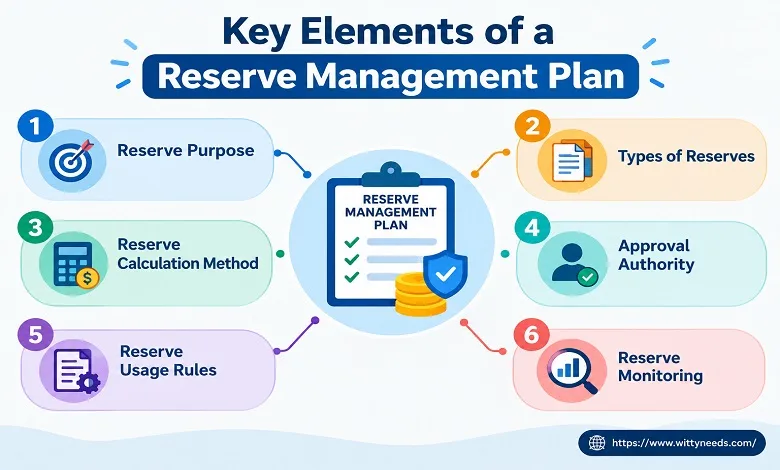
A practical reserve management plan does not need to be complicated. It should clearly explain how reserves will be handled from project initiation through completion.
1. Reserve Purpose
Start by explaining why reserves are being established. The purpose could include managing identified risks, absorbing schedule uncertainty, or providing management flexibility for unforeseen in-scope work.
This section should also clarify what reserves cannot be used for. For example, reserves should not automatically become a source of funding for unauthorized scope changes.
2. Types of Reserves
Identify the reserve categories used by the organization. This may include contingency reserve, management reserve, schedule reserve, or other categories relevant to the project.
Clearly defining each category helps prevent project team members from using the wrong reserve for a particular situation.
3. Reserve Calculation Method
Explain how the required reserve will be calculated.
For contingency reserves, the calculation may be based on identified risks and their estimated probability and impact. Expected Monetary Value is one possible approach. More complex projects may use quantitative risk analysis or Monte Carlo simulation to estimate potential cost or schedule exposure.
The calculation method should be appropriate for the project’s size, complexity, risk profile, and organizational requirements.
4. Approval Authority
A reserve management plan should clearly state who can approve reserve usage.
For example:
| Reserve Type | Possible Approval Authority |
| Activity contingency | Project manager |
| Project contingency | Project manager or project sponsor |
| Management reserve | Senior management or sponsor |
| Reserve above approved limits | Change control authority |
These are examples rather than universal rules. Each organization should define authority according to its governance framework.
5. Reserve Usage Rules
The plan should explain when a reserve can be used and what documentation is required.
A typical process may require the project manager to identify the event, explain its impact, confirm that the reserve is eligible for the situation, obtain the required approval, record the amount used, and update the relevant project records.
This creates an audit trail and makes it easier to understand where the project budget is being consumed.
6. Reserve Monitoring
Reserves should not be calculated once and then ignored.
As risks are closed, new risks emerge, and project estimates become more accurate, the required reserve may change. PMI describes reserve analysis as a way to evaluate project risk and determine whether schedule and budget reserves remain sufficient for the remaining risk.
Regular monitoring can show whether the reserve is being consumed faster than expected.
How to Create a Reserve Management Plan
Creating a reserve management plan can be approached as a structured process.
Step 1: Identify Project Risks
Start with the project’s risk register. Review known risks, their probability, potential impact, and planned responses.
The objective is not simply to list every possible problem. Focus on risks that could materially affect project cost, schedule, scope, quality, or delivery.
Step 2: Quantify Risk Exposure
Where appropriate, estimate the potential financial or schedule impact of identified risks.
A simple EMV calculation can be expressed as:
Expected Monetary Value = Probability of Risk × Potential Impact
For example, if a risk has a 30% probability of occurring and its estimated impact is $20,000:
0.30 × $20,000 = $6,000
This does not mean exactly $6,000 will be spent. It provides an expected value that can contribute to reserve planning.
Step 3: Determine the Required Reserve
Use the risk analysis to determine an appropriate reserve amount. Larger or more uncertain projects may require more sophisticated quantitative analysis.
Avoid automatically selecting a fixed percentage simply because it was used on another project. Reserve requirements should reflect the project’s actual risk exposure and organizational policies. PMI research has described quantitative approaches for developing contingency reserves using risk registers and EMV.
Step 4: Define Authorization Rules
Document who can approve reserve usage and what thresholds require additional approval.
For example, a project manager might have authority to approve smaller contingency expenditures, while larger management reserve releases may require sponsor approval.
Step 5: Establish Tracking Procedures
Create a reserve log or similar tracking mechanism.
A basic reserve tracking table might look like this:
| Date | Reserve Type | Opening Balance | Amount Used | Remaining Balance | Reason |
| Jan 10 | Contingency | $30,000 | $5,000 | $25,000 | Supplier delay |
| Feb 15 | Contingency | $25,000 | $3,500 | $21,500 | Rework |
| Mar 20 | Contingency | $21,500 | $4,000 | $17,500 | Integration issue |
This makes reserve consumption easier to monitor and communicate.
Step 6: Review and Update the Plan
Reserve planning should continue throughout project execution. As risks disappear or new information becomes available, the project team can reassess the reserve.
A reserve that was appropriate at the beginning of a project may no longer be appropriate several months later.
Reserve Analysis in Project Management
Reserve analysis is an important part of maintaining a realistic reserve position.
The basic idea is to compare the remaining project risk exposure with the reserve that is still available. If the remaining risks have increased while the reserve has declined significantly, management may need to reassess the project’s risk response or funding requirements.
For example:
| Project Stage | Remaining Risk | Reserve | Possible Action |
| Planning | High | $50,000 | Establish reserve |
| Early execution | Medium-high | $42,000 | Continue monitoring |
| Mid-project | Medium | $25,000 | Reassess exposure |
| Late project | Low | $15,000 | Review unused reserve |
| Closing | Very low | $8,000 | Determine disposition |
Reserve analysis can therefore support both cost control and risk discussions with stakeholders.
How Reserves Affect Project Budget and Cost Baseline
One area that often creates confusion is the relationship between reserves, the cost baseline, and the overall project budget.
Under current project management guidance, contingency and management reserves are distinct in purpose and authority, and organizations may structure the cost baseline differently depending on their framework and governance requirements.
A simplified model is:
Activity Cost Estimates + Applicable Contingency Reserve = Cost Baseline
The overall project budget may also account for management reserve where the organization’s approach places it outside the cost baseline.
Because terminology and treatment can vary between organizations, the reserve management plan should explicitly document how the project defines and controls each reserve.
Common Mistakes in Reserve Management
Poor reserve management can create problems even when the original project budget is accurate.
Treating Reserves as Extra Money
A reserve is not simply additional spending capacity. It exists for defined risk or governance purposes. Using it for unrelated expenses can hide underlying project problems.
Using the Same Percentage for Every Project
A fixed percentage may be easy to apply, but different projects have different risk profiles. A high-risk construction project and a relatively predictable internal software project may require very different reserve approaches.
Failing to Track Reserve Usage
If reserve withdrawals are not documented, stakeholders may have difficulty understanding why the budget is changing.
Mixing Contingency and Management Reserve
These reserves can have different purposes and approval requirements. Combining them without clear rules can create governance problems.
Never Reassessing the Reserve
Risk changes throughout the project. A reserve that was appropriate during planning may become excessive or insufficient later.
Best Practices for Reserve Management
A few practical habits can make reserve management more effective:
- Base reserves on risk rather than guesswork. Use the available risk information to support the calculation.
- Document approval authority. Everyone should understand who can release each type of reserve.
- Maintain a reserve log. Track additions, withdrawals, reasons, and balances.
- Review reserves regularly. Include reserve status in project risk and cost reviews.
- Keep reserves separate from unauthorized scope changes. Scope changes should follow the project’s change control process.
- Communicate reserve status. Sponsors and key stakeholders should understand how much reserve remains and why it has been used.
- Update assumptions. As project information becomes more reliable, revisit the reserve calculation.
- Record lessons learned. Reserve usage can reveal recurring risks that should be addressed in future projects.
Example of a Simple Reserve Management Plan
Consider a software implementation project with an approved cost estimate of $500,000.
The project team identifies several risks, including integration problems, vendor delays, and potential rework. After risk analysis, the team determines that $40,000 of contingency reserve is appropriate. Senior management also establishes a separate management reserve for unforeseen in-scope work according to the organization’s governance policy.
The reserve management plan could specify that:
| Area | Example Rule |
| Contingency reserve | Used for identified project risks |
| Management reserve | Used for eligible unforeseen in-scope work |
| Small contingency draw | Project manager approval |
| Larger draw | Sponsor or governance approval |
| Tracking | Recorded in reserve log |
| Review | Included in monthly project review |
| Reporting | Included in cost and risk reporting |
If a documented integration risk occurs and requires $8,000 of additional work, the project team can follow the established contingency process rather than treating the cost as an unexpected budget failure.
The important point is not the specific dollar amount. It is the existence of a clear process for deciding when and how reserve resources can be used.
FAQs About Reserve Management Plans
Q: What is a reserve management plan?
A. A reserve management plan defines how project reserves are calculated, approved, used, monitored, and updated to manage cost and schedule uncertainty.
Q: What is the difference between contingency reserve and management reserve?
A. Contingency reserve generally addresses identified risks, while management reserve is intended for unforeseen work within the project’s approved scope. The exact governance and budget treatment can vary by organization.
Q: How is contingency reserve calculated?
A. It can be calculated using risk probability and impact, EMV, quantitative risk analysis, simulation, or other methods appropriate to the project.
Q: Who controls management reserve?
A. Management reserve is commonly controlled by senior management or the project sponsor, although the responsible authority depends on organizational governance.
Q: Should reserve usage be tracked?
A. Yes. Tracking reserve usage helps project managers understand remaining financial protection, explain budget changes, and identify trends in project risk.
Final Thoughts
A reserve management plan gives project teams a practical framework for dealing with uncertainty. Instead of treating unexpected costs and delays as isolated surprises, the team can establish clear rules for preparing, approving, tracking, and reviewing reserves.
The most effective approach is to connect reserve planning with risk analysis, cost control, project governance, and regular project reviews. When reserves are based on realistic risk information and managed transparently, they can provide useful protection while keeping project decisions accountable.