

Building a successful online store requires more than adding products to a website. Businesses need an attractive storefront, smooth navigation, secure payment options, and features that make shopping convenient. This is why Shopify development services are valuable for businesses planning to establish or improve their ecommerce presence.
Shopify provides tools for creating and managing online stores, but businesses often need additional customization to match their brand identity and operational requirements. Professional development can help with store setup, theme customization, application integration, website migration, and performance improvements.
This guide explores the essential Shopify development services, their benefits, and how to choose the right development partner for your ecommerce project.
What Are Shopify Development Services?
Shopify development services involve creating, customizing, and maintaining ecommerce websites using the Shopify platform. These services help businesses build storefronts that support their products, customers, and day-to-day operations.
Depending on project requirements, development may involve customizing an existing theme, building a new storefront, integrating third-party applications, or connecting Shopify with external business systems.
Common services include:
- Shopify store setup and configuration.
- Custom theme development and customization.
- Product and collection page development.
- Shopify app development and integration.
- Ecommerce website migration.
- Shopify Plus development.
- Website performance optimization.
- Technical SEO implementation.
- Ongoing maintenance and support.
The right combination depends on the store’s size, business model, functionality requirements, and budget.
Why Do Businesses Need Professional Shopify Development?
Shopify makes it possible to launch an online store without building an ecommerce platform from scratch. However, businesses with specific design and functionality requirements may need professional development.
Read Also: White Label PPC Services for Agencies That Want to Scale
Customized Store Design
A professionally designed storefront helps communicate a brand’s identity through consistent colours, typography, layouts, and product presentation. Developers can customize themes to create a shopping experience that matches the business.
Better Customer Experience
Clear navigation, organized product categories, useful filters, and a simple checkout journey help customers browse products more easily. A well-structured store also makes important information easier to find.
Business-Specific Features
Some businesses require functionality beyond standard theme settings. Custom development can support product personalization, specialized pricing, subscription features, and integrations with external systems.
Mobile-Friendly Shopping
A responsive storefront adapts to different screen sizes, allowing customers to browse and purchase products from smartphones, tablets, and desktop computers.
Support for Future Growth
As a business expands, it may need additional product categories, new integrations, international selling options, or improved inventory management. A well-planned Shopify website can accommodate changing requirements.
10 Essential Shopify Development Services
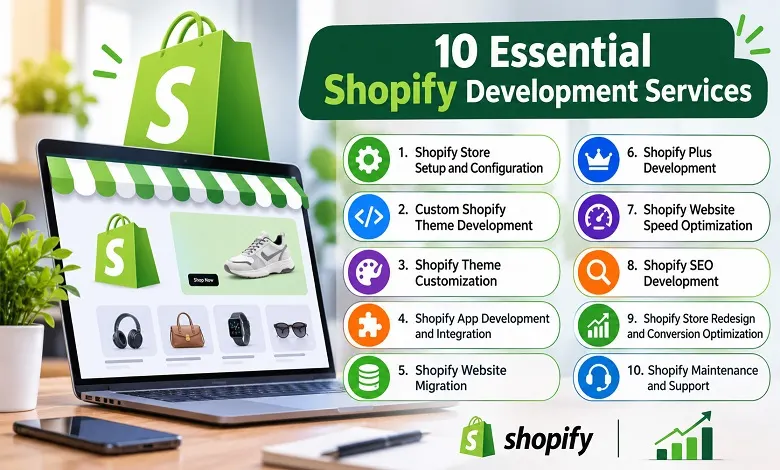
Shopify offers several development possibilities for businesses with different ecommerce needs. Understanding these services helps store owners identify the right solutions for their projects.
1. Shopify Store Setup and Configuration
Store setup involves preparing the Shopify environment and configuring the essential settings required to operate an online business.
This service typically includes domain configuration, product uploads, collection creation, navigation setup, payment configuration, shipping settings, and important store pages. Developers may also install and configure suitable applications.
Proper configuration creates a reliable foundation for managing products, orders, and customers.
2. Custom Shopify Theme Development
A Shopify theme controls the appearance and layout of an online store. Custom theme development is useful when a business needs a distinctive storefront that cannot be achieved through standard theme settings.
Developers use Shopify Liquid, HTML, CSS, and JavaScript to build custom layouts, reusable sections, product templates, and interactive elements.
This approach gives businesses greater control over the website’s appearance and functionality while keeping the storefront aligned with their brand.
3. Shopify Theme Customization
Businesses do not always need a completely new theme. Customizing an existing Shopify theme can be a practical option when the basic structure already meets their requirements.
Theme customization may involve changing page layouts, adjusting typography, modifying navigation, improving product displays, and adding custom sections.
It can provide a more personalized storefront without requiring an entirely new theme development project.
4. Shopify App Development and Integration
Shopify applications extend store functionality and help businesses manage different e-commerce activities. Common application categories include product reviews, email marketing, subscriptions, inventory management, loyalty programs, and customer support.
Professional developers can configure suitable applications and connect them with the store. When existing applications cannot meet a specific requirement, custom app development may be necessary.
Applications should be selected carefully to avoid unnecessary costs, overlapping functionality, and performance problems.
5. Shopify Website Migration
Businesses operating on platforms such as WooCommerce, Magento, or BigCommerce may decide to migrate their ecommerce websites to Shopify.
Migration involves transferring relevant information and rebuilding the storefront within the new platform. Depending on the project, this may include:
- Product details and variants.
- Customer information.
- Order records.
- Product images and media.
- Categories and collections.
- Blog posts and website content.
- Existing URLs and metadata.
SEO should be considered throughout the migration process. Important URLs need to be mapped, appropriate 301 redirects implemented, and key pages checked after the transfer.
6. Shopify Plus Development
Shopify Plus supports businesses with more advanced ecommerce and operational requirements. It may be suitable for organizations that need additional customization, complex integrations, or business-to-business selling capabilities.
Development projects may involve custom storefront features, B2B functionality, workflow automation, supported checkout extensions, and connections with external business systems.
Businesses should evaluate their actual requirements before choosing Shopify Plus, as not every growing store needs an enterprise-level solution.
7. Shopify Website Speed Optimization
Website performance influences how customers experience an online store. Large images, unnecessary scripts, excessive applications, and inefficient theme code can contribute to slow-loading pages.
Shopify performance optimization may include image compression, application reviews, code improvements, font optimization, and testing important pages on different devices.
Developers can also monitor Core Web Vitals to identify areas where loading performance, responsiveness, and visual stability need improvement.
8. Shopify SEO Development
SEO-friendly development helps search engines discover and understand important pages on an ecommerce website. It should be considered during the initial development process rather than treated as an afterthought.
Important Shopify SEO activities include:
- Optimizing page titles and meta descriptions.
- Creating descriptive product and collection content.
- Reviewing canonical URLs.
- Configuring XML sitemaps and robots.txt.
- Improving internal linking.
- Adding relevant structured data.
- Optimizing images and alt text.
- Checking mobile usability and page performance.
These technical foundations support broader SEO efforts, but rankings also depend on content quality, competition, website authority, and ongoing optimization.
9. Shopify Store Redesign and Conversion Optimization
An existing store may need a redesign when its appearance, navigation, or shopping experience no longer meets customer expectations.
A redesign project typically evaluates the homepage, product pages, collection layouts, navigation, cart experience, and mobile usability.
Conversion optimization focuses on making the purchasing journey clearer and reducing unnecessary obstacles. Changes should be guided by customer behaviour, website analytics, and appropriate testing.
10. Shopify Maintenance and Support
Launching a Shopify website does not mean development work is permanently complete. Stores may need technical updates, troubleshooting, new features, and integration improvements as business requirements change.
Maintenance services can include fixing theme issues, reviewing application compatibility, testing important functions, monitoring performance, and updating custom code when necessary.
Regular checks help businesses maintain a more reliable storefront and address problems before they affect important customer activities.
Read Also: Custom Logistics Software Development: A Complete Guide
Technologies Used in Shopify Web Development
Professional Shopify web development services involve several technologies and platform tools. Each has a different role in creating and maintaining an e-commerce storefront.
Shopify Liquid: Shopify’s template language, used to display store information and create dynamic theme components.
HTML and CSS: HTML provides page structure, while CSS controls layout, typography, spacing, and responsive design.
JavaScript: Supports interactive storefront features, including dynamic product options and navigation elements.
Shopify APIs: Allow applications and external systems to interact with supported Shopify store data and functionality.
Webhooks: Send event notifications to connected applications, helping businesses automate workflows such as order processing and inventory updates.
The technologies required depend on the project. A basic theme customization generally involves different development work from a custom application or complex integration.
How to Choose the Right Shopify Development Company
Selecting a development partner is an important decision because the quality of development can affect store usability, performance, and long-term maintenance.
Consider these factors before making a decision.
Review Shopify Experience
Look for developers who have worked with Shopify themes, Liquid, application integrations, and ecommerce websites. Relevant project examples can help you understand their capabilities.
Check Technical Knowledge
A reliable development partner should understand responsive design, APIs, theme customization, performance optimization, and platform-specific requirements.
Understand the Project Scope
Ask for a clear proposal covering design, development tasks, deliverables, estimated timelines, revisions, and post-launch support.
Evaluate Communication
Regular updates and clear explanations help keep projects organized. You should understand what is being developed and how any technical decisions affect your store.
Consider Long-Term Support
Confirm that you will have access to your Shopify store, domain, relevant assets, and necessary documentation. Also ask how future improvements and technical issues will be handled.
Shopify Developer vs. Shopify Development Company
A Shopify developer is an individual professional who builds, customizes, or maintains Shopify stores. A development company may provide a team covering design, development, project management, and technical support.
| Shopify Developer | Shopify Development Company |
| Usually works independently | May provide a team of specialists |
| Suitable for specific development tasks | Can handle larger ecommerce projects |
| Direct communication with one professional | Communication may involve multiple team members |
| Capacity depends on individual availability | May have additional resources for complex work |
The right choice depends on project size, budget, technical requirements, and the level of support needed.
Read Also: Development Services Technology Partnership Integration: The Complete Guide for Modern Businesses
Common Shopify Development Mistakes to Avoid
Poor planning can create technical problems and make an online store difficult to manage. Some common mistakes should be considered before launching a Shopify website.
- Installing too many applications: Unnecessary applications can increase costs and introduce additional scripts.
- Ignoring mobile usability: Product pages, menus, and buttons should work properly on smaller screens.
- Using duplicate product descriptions: Original and informative product content helps customers understand product differences.
- Overcomplicating the design: Excessive animations and pop-ups can distract visitors from important shopping information.
- Neglecting technical SEO: Incorrect redirects, missing metadata, and poor internal linking can create avoidable problems.
- Skipping website testing: Payment methods, shipping rules, forms, and integrations should be checked before launch.
Addressing these issues during development can reduce rework and improve the overall shopping experience.
Final Thoughts
A successful ecommerce store needs a combination of attractive design, useful functionality, reliable performance, and a convenient shopping experience. Shopify provides the platform, while professional development helps businesses adapt it to their specific requirements.
The right Shopify development services can cover everything from initial store configuration and theme customization to application integration, migration, SEO, and ongoing maintenance. Before selecting a development partner, evaluate their technical experience, project approach, communication, and long-term support.
Whether you are launching a new online business or improving an established store, investing in suitable Shopify website development services and Shopify web development services can help create a more professional and manageable ecommerce website.
Frequently Asked Questions
Q: What do Shopify development services include?
A. They include store setup, theme development, theme customization, application integration, migration, performance optimization, technical SEO, and ongoing maintenance. The exact services depend on the store’s requirements.
Q: How much do Shopify website development services cost?
A. The cost depends on design complexity, product volume, custom functionality, application integrations, and development time. A basic theme-based store generally requires a different budget from a custom storefront or Shopify Plus project.
Q: How long does Shopify website development take?
A. The timeline depends on the scope of work. A simple store setup may take considerably less time than a custom theme, complex integration, or large-scale ecommerce migration.
Q: Is Shopify suitable for small businesses?
A. Yes. Shopify provides tools for product management, order processing, payments, and storefront customization, making it a suitable option for many small businesses entering ecommerce.
Q: What is the difference between Shopify theme customization and custom theme development?
A. Theme customization involves modifying an existing theme, while custom theme development involves building a theme or substantial storefront components around specific design and functionality requirements.
Q: Can an existing website be migrated to Shopify?
A. Yes. Ecommerce websites can be migrated from platforms such as WooCommerce, Magento, and BigCommerce. The process may include transferring products, customer records, orders, content, and important URLs.
Q: Do Shopify websites need SEO?
A. Yes. SEO helps potential customers discover products through search engines. Shopify websites benefit from optimized product pages, useful content, technical SEO, internal linking, and ongoing performance monitoring.
Q: What is Shopify Plus development?
A. Shopify Plus development involves customizing stores for businesses with more advanced requirements, such as B2B commerce, supported checkout extensions, complex integrations, and workflow automation.
Q: Do Shopify stores require ongoing maintenance?
A. Ongoing maintenance can help identify technical issues, review application compatibility, maintain custom functionality, and support new business requirements.