
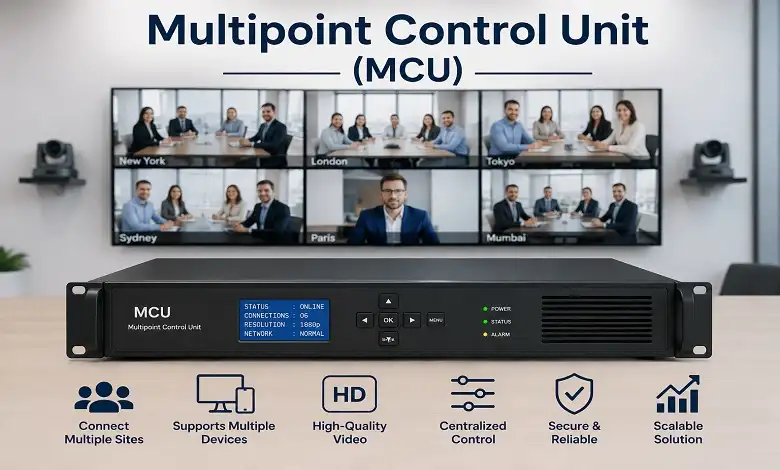
Video conferencing has become an essential part of modern communication. Businesses, educational institutions, healthcare providers, and government organizations all rely on virtual meetings to collaborate with people in different locations. While joining a video call is simple for most users, the technology that makes multi-person meetings possible is much more complex. One of the key components behind many enterprise video conferencing systems is the Multipoint Control Unit (MCU).
An MCU acts as the central hub for multiparty video conferences, making it possible for several participants to communicate in the same meeting while maintaining high-quality audio and video. Although newer conferencing architectures have emerged over the years, MCUs continue to play an important role in environments where compatibility, centralized management, and media processing are priorities.
This guide explains what a Multipoint Control Unit is, how it works, its main components, benefits, limitations, and when it remains the right choice for video conferencing.
What Is a Multipoint Control Unit?
A Multipoint Control Unit (MCU) is a hardware appliance or software application that enables three or more participants to join a single video conference. Instead of each participant sending video and audio directly to every other participant, every endpoint connects to the MCU.
The MCU receives all incoming media streams, processes them, and sends optimized streams back to each participant. This centralized approach simplifies communication and ensures that users with different devices, resolutions, codecs, and network conditions can participate in the same meeting.
Because the MCU handles media processing, individual devices do not need to perform complex calculations, making it easier for older systems and dedicated conferencing equipment to participate in large meetings.
How Does an MCU Work?
An MCU serves as the meeting’s central processing point. Every participant uploads their audio and video to the MCU rather than directly to other attendees.
Once the streams arrive, the MCU performs several important tasks.
Receiving Media Streams
Each participant sends separate audio and video streams to the MCU. Whether five people or fifty people join a meeting, every endpoint communicates with the central server instead of maintaining multiple direct connections.
Media Processing
After receiving the streams, the MCU decodes the incoming audio and video. It processes the content, synchronizes the streams, and prepares them for distribution.
Depending on the conference settings, the MCU may create a gallery view showing every participant, highlight the active speaker, or generate customized layouts for different users.
Audio Mixing
One of the MCU’s primary responsibilities is audio mixing. It combines voices from multiple participants into a synchronized stream while reducing background noise and preventing overlapping audio from affecting the conversation.
This creates a more natural meeting experience even when many participants are speaking.
Video Processing
Video streams often arrive in different resolutions and formats. The MCU processes these streams so every participant receives a compatible version based on their device capabilities and network conditions.
The server may also resize video windows, switch layouts, or prioritize the active speaker automatically.
Sending Optimized Streams
Once processing is complete, the MCU distributes the outgoing media streams to every participant. Each user receives a conference feed designed to provide smooth playback and consistent quality.
Main Components of an MCU
A typical Multipoint Control Unit consists of two major components.
Multipoint Controller (MC)
The Multipoint Controller manages conference signalling and overall session control. It handles participant management, conference creation, capability negotiation, and communication between connected endpoints.
The controller ensures every participant joins the meeting correctly and supports compatible communication parameters.
Multipoint Processor (MP)
The Multipoint Processor performs the media-intensive work required during the conference.
Its responsibilities include:
- Audio mixing
- Video mixing
- Stream switching
- Video transcoding
- Resolution adjustments
- Layout generation
- Media synchronization
Together, these components allow the MCU to manage complex multiparty conferences efficiently.
Types of Multipoint Control Units
Organizations can choose different types of MCUs depending on their infrastructure and conferencing requirements.
Hardware MCU
Hardware MCUs are dedicated conferencing appliances designed specifically for processing audio and video streams.
They typically provide excellent reliability and performance, making them suitable for organizations with demanding conferencing requirements.
Software MCU
A software MCU runs on standard servers or virtual machines rather than specialized hardware.
Software-based solutions are generally easier to deploy, update, and scale while reducing hardware investment.
Cloud MCU
Cloud-based MCUs are hosted by service providers and accessed through the internet.
Businesses can add conferencing capacity without purchasing dedicated infrastructure, making cloud deployment attractive for organizations with remote or distributed teams.
Advantages of Using an MCU
An MCU offers several important advantages for enterprise video conferencing.
Supports Multiple Participants
The primary benefit of an MCU is its ability to connect several participants in a single meeting while maintaining synchronized communication.
Better Compatibility
Different users often have different devices, operating systems, codecs, and network capabilities.
The MCU processes media centrally, allowing participants with varying technical environments to communicate without major compatibility issues.
Reduced Client Workload
Because the MCU performs media processing, participant devices require less processing power.
This makes MCUs especially useful when supporting legacy conferencing equipment or low-powered devices.
Centralized Conference Management
Administrators can manage meetings, monitor system performance, allocate resources, and troubleshoot issues from one centralized location.
Improved Recording
Since all conference media passes through the MCU, recording meetings becomes simpler and more consistent.
Organizations that require archived meetings often benefit from centralized recording capabilities.
Limitations of an MCU
Although MCUs provide many advantages, they also have certain limitations.
Higher Processing Requirements
Media processing requires significant computing resources.
As conferences grow larger, server CPU utilization increases because every audio and video stream must be decoded, processed, and re-encoded.
Increased Infrastructure Cost
Dedicated hardware and high-performance servers can increase deployment and maintenance costs compared to simpler conferencing architectures.
Additional Latency
Because the MCU processes every stream before redistribution, meetings may experience slightly higher latency than architectures that forward media directly.
For most enterprise meetings, this delay is acceptable, but extremely latency-sensitive applications may prefer alternative approaches.
Scalability Challenges
Supporting a large number of simultaneous conferences requires additional server resources, making capacity planning an important consideration.
Common Applications of an MCU
Despite the growth of newer conferencing technologies, MCUs remain valuable in many industries.
Business Collaboration
Large organizations use MCUs to connect employees working across multiple offices and countries.
Healthcare
Hospitals and healthcare providers use secure video conferencing for remote consultations, specialist collaboration, and medical training.
Education
Universities and training organizations rely on MCUs for online classrooms, lectures, and interactive learning sessions.
Government
Government agencies often require centralized conferencing systems with strong management and compatibility features.
Financial Services
Banks and financial institutions utilize enterprise conferencing solutions to facilitate secure meetings among branches, partners, and clients.
Conclusion
A Multipoint Control Unit (MCU) remains a key technology for professional video conferencing. By receiving, processing, and redistributing audio and video streams through a centralized platform, it enables reliable communication between multiple participants while supporting a wide range of devices and network environments.
Whether deployed as dedicated hardware, software, or a cloud-based service, an MCU helps organizations manage conferences more effectively, improve compatibility, simplify administration, and deliver a consistent meeting experience. While alternatives such as SFUs have become increasingly popular for modern web-based conferencing, MCUs remain a dependable solution for enterprises that require robust media processing, interoperability, and centralized control.
Frequently Asked Questions (FAQs)
Q: What is a Multipoint Control Unit (MCU)?
A: A Multipoint Control Unit (MCU) is a hardware or software-based conferencing server that enables three or more participants to join the same video conference. It receives audio and video streams from all participants, processes them, and distributes optimized streams back to each attendee for a seamless meeting experience.
Q: How does a Multipoint Control Unit work?
A: An MCU acts as the central hub of a video conference. It collects media streams from each participant, decodes and processes the audio and video, combines or switches the streams as needed, and sends the processed media back to all connected users.
Q: What is the primary purpose of an MCU?
A: The main purpose of an MCU is to manage multiparty video conferences by handling media processing, improving compatibility between different devices, optimizing bandwidth usage, and delivering synchronized audio and video to all participants.
Q: What is the difference between an MCU and an SFU?
A: An MCU processes and mixes audio and video streams before sending them to participants, reducing the workload on client devices. An SFU (Selective Forwarding Unit), on the other hand, forwards individual media streams without mixing them, resulting in lower server processing but requiring more resources from participant devices.
Q: Is an MCU hardware or software?
A: An MCU can be either hardware-based or software-based. Hardware MCUs are dedicated appliances designed for enterprise conferencing, while software MCUs run on standard servers or cloud infrastructure, offering greater flexibility and scalability.
Q: Where are Multipoint Control Units commonly used?
A: MCUs are widely used in enterprise video conferencing, healthcare, education, government organizations, financial institutions, legal services, and any environment where reliable multi-party communication is essential.
Q: Does an MCU support SIP and H.323 protocols?
A: Yes. Most enterprise-grade MCUs support both SIP (Session Initiation Protocol) and H.323, allowing them to connect various video conferencing endpoints and ensure interoperability between different communication systems.